Showing posts with label Culture. Show all posts

Wednesday, March 1, 2017

Wandering in Wantonness, Yearning for Freedom


Why is it that the more I desire freedom, the less of it I have? 

Am I too irresponsible with the freedom I do have? Do I hold so tightly to my freedom that I crush it, like a child might crush a flower in their hand in their effort to protect it? I know that love can be bruised, and even extinguished, if held too tightly—I have been the constrictor and constricted at different points in my life. Love cannot flourish without freedom. 

So too, freedom cannot be true freedom without boundaries, else it becomes anarchy or licentiousness: "[Freedom] requires efforts, it presupposes mental and moral qualities of a high order to be generally diffused in the society where it exists" said John C Calhoun. Freedom must be tempered with morality, or the free-will of one may suffocate or imprison the will of another. Self-determination can easily become selfishness. When I rejoice in my deliverance rather than my Deliverer, I have made an idol out of a gift. 

My history tutor succeeded in teaching me at least one thing in my eight weeks of Oxford learning: Rights entail responsibilities. According to the Declaration of Independence, freedom is a God-given right. Life is a right. Private ownership of things [not people] is a right. With these rights then, come responsibilities. A right is a moral duty, a rule of conduct; it is a just claim and a privilege. When we want a right without assuming the responsibility it entails, it will crumble. Thus, when I want freedom on my terms, I find what I have called freedom is hollow, crumpled in my grasping hand. When I buck the parameters given because they feel confining, am I asserting freedom of will or willful selfishness? 

I want the bit in my teeth so I can have my head. I want to come and go as I please at work, but I need to be subject to the hours of operation, to be available to my co-workers. All the other hours of the week are my own. If I squander my mornings with sleep, having stayed up too late, is that the fault of my work for being too early, or my own, for being undisciplined? And if I feel stifled at work by having to remain indoors on a lovely day, haven't I chosen a job that is predominantly indoors? I have chosen to be subject to that parameter by choosing this job over another. Have I stifled my freedom to go hiking or to sit on my porch to read or write? By no means. There are certain hours of the day when I have chosen not to pursue those things, but they are still mine to pursue on off days and off hours. Further, I couldn't afford car insurance or gasoline, housing or food if I didn't have a job, so I would be less free to live in a mountainous state to hike in if I didn't have my job. 

Freedom has its framework, keeping it from becoming an amorphous, languid, insipid dissipation. I am only free to communicate in writing if I obey the rules of grammar. I am only free to hike if I have strengthened my muscles; taken care to feed my body the right proteins, fruits, and vegetables; looked up a route and driven to it. I can't hike in Buena Vista if I don't get in my car and drive two hours away in the right direction. Because I live in this place, I necessarily do not live in any other place. Is that somehow not free?

I now come back to love not being true love without freedom. When you feel like you have to love someone back because they care so much about you, is that really love or obligation? By very definition, the word obligation means binding. And while freedom involves duty and staying within morality—like a thought is only free to be expressed and understood when it is bound by proper punctuation—it is not binding, or non-freedom. A thing cannot be itself and its opposite. This is why God gave humans freedom of will. Yes, taken out of its parameters it is turned into anarchy, self-indulgence, and licence—these broken forms being the heartbreak and death of millions and millions throughout history. 

Yet what a difference it is to freely give love, without feeling we have to! If we were obligated to love God because He loves us, rather than being allowed to choose to love Him, that would not be love. It would be duty, it would be bindingly obligatory, it would be dull and colourless. I have tried to cause my heart to love warmly because I was loved and felt I must love in return. I have tried to be friends with people who were so needy for love that they grasped at friendship and affection. These relationships do not work. They frustrate and wound both people. When the Bible says we love because God first loved us, it does not mean that we feel we are expected to love God because He loved us. It means we are overwhelmed, awed by His love for us. We are humbled by His love and we want to return it, we want Him to be loved, too! This real love appears similar to loving out of duty, but the difference is in the heart. We gladly lay down our lives, give of our time and heart with no trace of resentment or drudgery.

Freedom is not unrestrained frolic and revelry, as our culture often thinks. That is the definition of wantonness. In fact, wantonness is said to be, "resistant to control, willful; a discordant sound." I shuddered at this definition, because it so accurately describes my heart. I resist control in my heart and in my words. I am willful and selfish. The older I get, the more I find how self-absorbed I am. That makes for a discordant strain in God's harmony. Like Melchor in The Silmarillion, or the little farandolae in A Wind in the Door, I sing my own song, thinking that it is better to be myself than to be part of the mighty chorus, the rooted, life-giving farandola. I want to do my own thing rather than being confined by doing what others want. And in some ways, that is good. I shouldn't go along with the crowd of our culture. But I am a member of the Body of Christ, not an individual. It is freedom to live with, to serve with, to give myself for Jesus—and He says I do that by being part of His body. I don't lose myself by being part of Him. I do not make music by singing my own song, I make discord. When I sing with the host of heaven and the saints, we shake the universe with the song of Illúvitar, the mighty chorus vibrating life and creativity and joy into every atom and galaxy.

All this time I have been grasping at wantonness, lack of restraint. I have not been yearning for freedom after all, I have been craving self indulgence: 
"Where there is no revelation, people cast off restraint; but blessed is the one who heeds wisdom's instruction" (Prov 29:18 NIV).  
Or as the ESV says, "Where there is no prophetic vision the people cast off restraint, but blessed is he who keeps the law."  
Prophetic vision and the instruction of wisdom are our parameters; they are the complete thought bound in a sentence, the melody of the symphony. The head of the Body is Christ—the Head has the eyes, and through the brain, the eyes communicate to the rest of the body what it should do. The wisdom and the vision come from Christ through His prophets, apostles, and teachers. I have rarely found these people leading a church, but I have shared many a meal with them around a table, exchanged letters and calls with them, read their books, and lived and worked alongside them. 

Freedom is not unrestraint—that is wantonness. Yet it is not a binding cord, either. Freedom is not a chain, it is a channel. A river that overflows its banks is out of control, damaging property, sometimes killing people. People who cast off restraint are said to run wild, often doing much more harm than a surging river or stampeding [uncontrolled] herd. "That which we restrain we keep within limits; that which we restrict we keep within certain definite limits; that which we repress we try to put out of existence" (Century Dictionary, 1902). When I try to cast off restraint, I am not pursuing freedom. When I seek God's wisdom, it represses sin in me, crucifying my flesh so that I might be fully alive to Christ in my spirit. When I seek God's vision, when I heed wisdom's instruction, then—and only then—am I free. 


Monday, February 8, 2016

Planned Obsolescence and a Culture of Death


"Oh, I know how to use that mixer, my grandma's is just like it!" I said to my hostess as she pulled out her mother's mixer. She looked pleased and then sighed, "Yes, this one is still plugging away, unlike the things they make now. Planned obsolescence they call it. So your products have a life-span of only a few years." The term was not new to me, nor the concept—but that didn't stop the conversation from bothering me. Manufacturers don't want to make a sturdy product, they want to make a cheap product that has you coming back to them every few years. They mismanage our resources—plastic, metal, glass, labour—in order to make a profit.

Far from being a mere economic tactic, planned obsolescence makes its way into other areas as well. The trend of building ugly-but-functional buildings has been the rage for quite a while, with the added 'luxury' of being able to demolish the building at will if it gets outmoded, overcrowded, underused, or any number of other reasons. When I lived in Oxford for a term, I felt at peace even on the fast-paced sidewalks, because I could always duck into an ancient alleyway, or take the next block up. Even if I stayed on George Street, the buildings were far older than anything Colorado can boast, the churches beautiful and unambiguously churches, and one could hear bells chime the quarter hours from anywhere in the city.

Oxford was not built to be replaced one building at a time—as evidenced by a building from the 1500s on a main thoroughfare. Granted, that house was being used as a mobile phone store, but they hadn't torn it down to build a disposable storefront. The English built things to last far into time. Architects like Christopher Wren built beautiful libraries, chapels, cathedrals, and colleges to last—sometimes dying before the work was finished because of the precision and enormity of the building process. It was no light matter to build a cathedral or a school. They would be a place of teaching and refuge for generations to come, they must be built well, they must be beautiful and inspiring in their construction.

This same mindset of building things to last was brought by the English who settled the American Colonies. The earliest cities in America have some lovely architecture, buildings that have withstood the elements and fads. However, in the early 1900s came this ploy of obsolescence. From buildings and cars to mixers and light bulbs, manufacturers began the process of making things disposable. Now we are deluged with plastic containers, glass bottles, and ubiquitous grocery bags made merely to be thrown away. I am two generations down from the 'Greatest Generation' who lived through the Great Depression and the recycling drives of World War II. In two short generations, we have gone from conserving to consuming-with-abandon. The shift began with things like planned obsolescence and it has grown into a killing field.

The industrial revolution turned the whole of humanity into two groups: consumers and producers. Distinctions made by man to obfuscate our calling as human beings, imaging God. Human beings began to be redefined under man's terms, a slippery position for anyone. When persons are defined as either consumers or producers, immediately they are given different values. Rather than the intrinsic worth of being human—made in God's image—humans are given arbitrary values based on their production or use in society. People become what they do, rather than who they are.

When a person too weak and small to fight for themselves is considered a hindrance, it's okay, they are disposable. A quick 'procedure' and presto! the unwanted 'problem' is gone. Snuffed out by 'progress' and a woman's 'right' to kill another person. But if you call a person a 'problem' and say 'remove tissue' rather than 'kill' it sounds less like murder—it's much more sanitary that way. What happens when a person is old and unable to contribute to society? They are shuffled off into homes; separated from families who need to be reminded that everyone deserves compassion, that they themselves are not immortal, that death comes for us all. But we shove aside death and thoughts of our mortality, rushing on in the consumer-producer wheel. Worse still, many elderly are shuffled off this mortal coil by doctors, nursing home workers, or other 'aides' when there isn't enough money or room to pour into a 'useless' person. But human beings are not machines, they are not their ability to produce. They are not animals. They are image bearers, beings—full of worth because they are made in the likeness of God, unlike any other creature.

Manufacturers are not really to blame for abortion and euthanasia—their planned obsolescence is only a symptom of a shift in thinking and beliefs. The philosophies of eighteenth, nineteenth, and following centuries have come to fruition in this culture of disposable stuff and disposable humans. If it breaks, buy a new one. If it's old, throw it away. The jump from stuff to humans isn't far when you base human value on what one does, rather than upon who one is. No wonder God calls us to be stewards, caretakers of resources (oil, plastic, glass, plants, time, money), as well as one another. We are to steward—guard and care for—human beings even more than we are to till the ground or cultivate our imaginations or repair our cars and mixers. We are to cultivate our hearts and minds and culture into thriving grounds for life.

Sunday, November 8, 2015

To Be Fully Known


And I don't want the world to see me...
...I just want you to know who I am1

Omaha, Nebraska. That paragon of culture is precisely where I spent a long weekend with friends. Now, I know that many of you will think of steak, cornfields, and farmers when you hear the word Nebraska, but there is quite a lot to that Plains State aside from plains. The highlights of my weekend were all cultural experiences: from the Joslyn Art Museum, a symphony, and a gourmet dinner, to a tea emporium, exploring the grounds of a mansion, and spending time in prayer at a beautiful Catholic edifice.


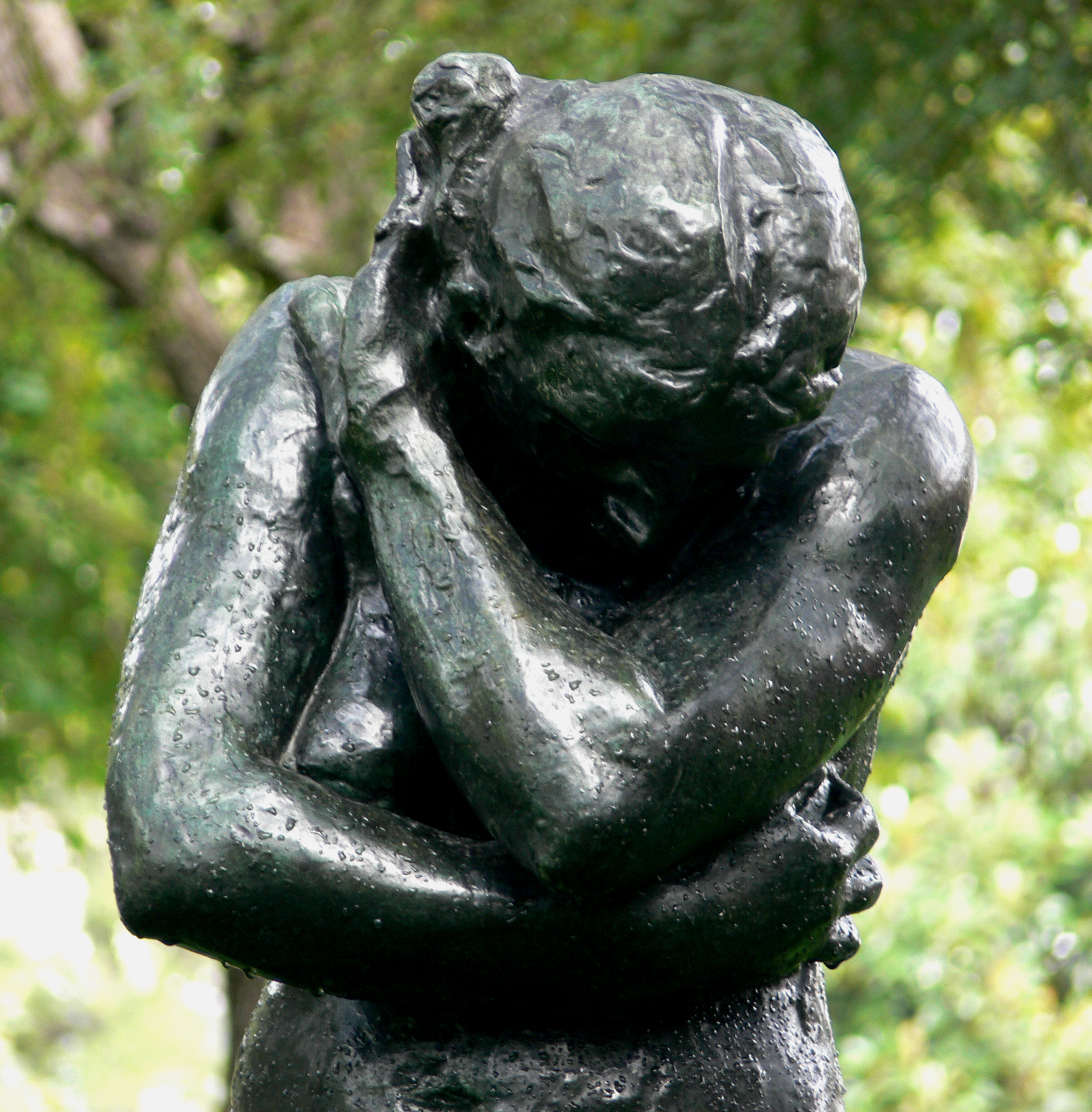
Though we spent less than an hour at the Joslyn Art Museum, it was meditative time well invested. Upon exiting the European art section, there was a small room containing a Monet painting and a small bronze statue of Auguste Rodin's Eve. Unlike many portrayals I have seen of Lady Eve, this one was not sensual nor was it sanitised. There she was, naked, with no hand covering her sexuality, no long hair hanging down to hide her womanhood; she hid only her face. Though she was bronze she was not brazen—contorted in remorse and agony for the curse she had unleashed upon mankind. When I gazed upon this mortified Eve, I saw fear and sorrow. I saw vulnerability. I saw humanity in the wake of the Fall. I saw the hope of repentance. I saw myself.


How can human hands take cold metal, making it live in ripples, effulgence, and emotion? How could the artist cast one woman who would resonate with so many of the women who gazed upon her abject form? Yet somehow, in broad strokes, Rodin made just such a woman. Eve in all her remorse and repentance was a woman—she was human. From this bitter moment of knowing sin, a veil was placed between God and man. 


From this time forth, humans began to hide—and we choose to hide behind much more than fig leaves and excuses. We hide behind our accomplishments or our identity, behind our careers, cars, or kids. We hide behind walls that we have built, brick by brick, barb by barb. We hide behind our intellect and our to-do lists, behind styles and having it all together, behind addictions and amusements—we hide because we are afraid. We are afraid that we aren't smart enough, handsome enough, or successful enough. We are afraid to let anyone see our mess, our turmoil, our uncertainties, our weaknesses and inabilities. And when our first emotion isn't fear, it is fear hidden under the guise of pride. We pride ourselves on our achievements or our brutal honesty or some other thing, in order to prove that we are enough, we are strong, we are worthy of love and acceptance, or at least of respect and awe.

What if we were like Eve, not hiding our humanity—for it is our glory, our being what we were made to be. What if we did not try even to turn our eyes away from our Maker in agony and ignominy? What if we recalled Isaiah's words, that our Maker is our Husband and that the Holy One is also our Redeemer (Isaiah 54:3)? What if He turned our faces toward Himself, sought our eyes with His, and called us His belovéd? There is no "what if?" about that—He does exactly that. From the very first He has pursued us. 


Beginning with Adam and Eve, in the cool of the evening the Lord sought them, He called out to them "where are you?" (Genesis 3:9). Adam answers the way I so often do, "...I was afraid, because I was naked, and I hid myself." (Genesis 3:10) "...I was afraid, because I was naked..." I was afraid to come to You, Lord, because You would see through my accolades, accomplishments, and intellect. I felt vulnerable and raw, so I didn't want to come before You. I have sinned and I couldn't wash it off. I want to fix myself before I come to You. Slowly, slowly I am learning that this is when He cups His hand under my chin and searches out my eyes. The searing Love in His own eyes burns away my impurities, illumines my darkness, heals my brokenness, makes me worthy. It isn't that there is no consequence for sin, there is. Yet it remains that the payment was made by the injured party. The One who covenanted with us is the One who paid the redemption price when we broke the covenant. The Holy One is our Redeemer.


Like Eve, I forget the kindness of God that leads to repentance and I can think only of His Holiness. I forget that His wrath is directed toward my sin, not my self, so I hide. I try to be fit enough, smart enough, encouraging enough, anything-else-enough-to-atone-for-myself—except being vulnerable enough, honest enough, and humble enough to come before Him. 


The irony in all my fears, in all my brokenness, is that I deeply want to be known—to have someone know me as I am and not walk away. Those great theologians, 
the Goo Goo Dolls, put it this way: And I don't want the world to see me/'Cause I don't think that they'd understand/When everything's made to be broken/I just want you to know who I am1. They understand the ache of every human being, the desire to be known—but also the fear of being known. We don't want the whole world to see us as we are, just the one person who will know us for ourselves and not run away. It is a scary thing to be vulnerable with another person. What if they betray you? What if they reject you? What if they take what they know about you and use it against you? That is the risk of love. A risk we fear and long to take, all rolled together.


Love is the risk God chose to take on mankind. He chose to create Adam and Eve, though He knew the Fall would happen. He chose to love them, even though He knew they would choose not to trust Him and would break the world He entrusted to them. He chooses to love us, even though we put up walls or try to win approval rather than receiving His gifts of love, reconciliation, and redemption. He chooses to love us, even though we often snatch gifts from His hand, yet run away from Him when we don't get our way. And even when we nail Him to a cross with our manifold sins, piercing Him to His very heart, He still loves us.


Perhaps I see less of myself in Eve after all—at least she stood before her maker in all her nakedness and sorrow. I run from my Maker in those moments, or try to cover myself with the flimsy fig leaves of my accomplishments and intellect. I ache to be known, yet I fear it. I want to be naked and unashamed before my Maker rather than clothing myself in my own attempts at being "enough".


“You come of the Lord Adam and the Lady Eve," said Aslan. "And that is both honour enough to erect the head of the poorest beggar, and shame enough to bow the shoulders of the greatest emperor on earth. Be content.2

O my Maker-Husband, let me be content in Your Love. Let me be vulnerable enough to come before You. Make me able to know that You are enough and that You make me worthy.


_______________


1. The Goo Goo Dolls, Iris (Written by John Rzeznik, Warner Bros. 1998)

2. Lewis, C. S., Prince Caspian (Scholastic Inc., New York, 1987) 211-212

All Scripture is taken from The Holy Bible, English Standard Version Copyright © 2001 by Crossway Bibles, a publishing ministry of Good News Publishers.

Saturday, August 1, 2015

The Liturgy of Home: Place and Practise


Fog diffuses light and shadow, shrouds the world around me in unfamiliar shapes, bringing with it the damp smells of earth and balsam. Raucous calls emanate from the rook perched amongst the pines. Watching, listening, I sit still—allowing the morning’s wild silence to feed my soul. I revel in weekends and mornings; their hours hold out strong fingers of life and help to me. A cheery kettle often whistles its tea-song as I poach an egg or wipe the table. Benedictine’s chant a Psalm whilst I wash the dishes, my own prayers rising with their strains and the water’s steam.

Morning rhythms thrum through my day, setting the tone for the day’s song. If I begin with a Psalm and moments for prayer, the first melody is strong. If I add to that the kitchen tidying and sweeping, a chord of harmony twines into the day. Weaving in reading or writing—if I have given myself enough time for leisure—the chorus grows more substantial by the time I greet my fellow workmates. This is home—this practise of cultivating habits and routines which chart the course of days and weeks.

I grew up in a home that was less focussed on punctuality and more concerned with ‘life together.’ My mother set routines both around the morning meal and reading Scripture aloud to me and my sisters. My father would engage us all in conversation over dinner, leaving time to read together after the table was cleared or just before bed. Sometimes we would shift our evening routine, having friends over for dinner or coffee. We would hold hands and pray together. There we were, gathered around the table, listening to stories and laughing over the trifling events of the day—glad for friends with whom we could share both words and meals.

Time swirls on as ever—I cannot believe how many years ago I grew up in my parents’ home. I have since moved to my own cottage, a tiny cabin peering out at the foothills of the Rocky Mountains. Here I have scrubbed, dusted, and decorated. I have laughed and cried, both with friends and alone. I have acquired and organised books and bookshelves. Here I have stocked cabinets with tea and food to serve at the whim of a knock. And here I have learned that being still is a practise—not an intrinsic right that comes with living solo.

It seems safe to say that home is a place of comfort and cheer, of peace and pleasure. If you do not believe me, think of the households where there is chaos, violence, stony silence, instability, or abuse. Out of these dens come hurting individuals, hungry for peace, yearning for safety and love. Acceptance and care, feeling like they belong, is the home-feeling they are looking for—whether it comes from a gang or a healthy family.

Indeed, home is a place, not a nebulous placeholder, like your internet browser’s so-called ‘homepage.’ Yet home is much more than a tactile frame of timber and glass. Home is a practise—the practical application of routines and daily liturgy. Home is private—a place to rest and a bulwark from the buffeting tempests of life-storms. Home is public—an open-door-hospitality sort of shelter for friends and family in times both of laughter and tears.

We live in a culture that is anything but home-like. It separates, drawing individuals off into solitary pursuits, or keeping families so busy that a meal together is an anomaly. Busy-ness and individualism are the antitheses to home life, community, and sanity. Keeping a frenetic schedule allows precious little time for reflection, an act of both soul and spirit that is needed to balance reality and dreams.

Knowing that reflection is an essential need, I make space for it in my mornings and weekends. Sometimes this means setting aside books and screens, simply looking out the window as I enjoy a meal, or sitting on my porch watching the rain drip from the pine needles. Other times, this means going for a solitary walk. As I was reflecting recently, I realised that the way my parents raised me and my sisters was not perfect, but it was good. The ‘life together’ aspect of the dinner table, of evening recreation, of opening our home or going to friends’ homes, of working together in the garden or to make dinner set a theme for my life. These things painted a robust and rich picture of home for me.

We need flourishing homes in our lonely, fragmented culture. Are our homes the sort that cast a beam of warm, golden light out into the dark of night? Do the weary, worn, busy travellers along the road of life find us—and our dwellings—places of solace? May the habits we practise—order, hospitality, togetherness, and reflection—shine out into the inky night as a beam of hope for all who see it and choose to come inside.

Saturday, June 20, 2015

Creativity Begets: How Story Inspires


As the cerulean sky bleeds into water-coloured grey storm clouds, my thoughts are somewhere between Middle Earth and Pluto. Ringing in my head is a stunning symphonic melody about Saturn—its strength in Beauty has captured my memory. Reverberating in my ears is the sound of Tolkien's prose—read aloud to hear the simultaneously earthy and heraldic tones played in his words.


Treading the paths of my thoughts are an interesting pair, hand-in-hand. The first is a comment made by John Wain, an English novelist, about the Inklings being a “circle of instigators, almost of incendiaries, meeting to urge one another on in the task of redirecting the whole current of contemporary art and life.”1 The second is the thought I have been mulling over in recent days: one individual's creativity often leads others to create. Or more succinctly, creativity begets creativity. Creativity in something well-crafted and beautiful breathes life into our souls in a way that makes us want to create, too.


This creativity is what spread from one Inkling to the next and the next—and back again. The inspiration, the life-breath, from Tolkien stirred the heart and mind of Lewis. The adamant Lewis argued and challenged the other Inklings—and when an idea is challenged, one must think long on it to see if it is true and worth fighting for or not. Charles Williams himself was inspiring to Lewis, enough to model Ransom after him in That Hideous Strength. These men were each "playing the potter to see what shapes [they could] make of another."2 Even as they moulded one another's thoughts and imaginations, they shaped the minds of men for generations to come.


Living in the wake of these men (and Dorothy L Sayers, often mentioned amongst this set), I find my own views of valour, honour, camaraderie, theology, and of God Himself shaped by the essays and stories of various Inklings. My picture of true friendship is painted by Frodo and Samwise. The image of honour, integrity, and discernment strides forth in the form of Faramir. My heart broke over the death of Aslan, helping me to connect with the death of Jesus in a much deeper way. The Voice in the fog* reminds me that God tells us no story but our own from His perspective. My rich, layered view of Heaven is painted with such real grass that it spears one's feet, and light so real that it crushes one from the shadowlands. Dorothy L Sayers' robust explanation of the Trinity in The Mind of the Maker made such a vivid impression upon me that, though I have only read the book once, much of it sticks with me still. So, I am fashioned by these long-dead hands—much for the better, I think.


Creativity shot through with Beauty has made its impression on me; has breathed its very life into me. I find I am most shaped by images and stories, more than by essays. The essays have moulded my thoughts, certainly, but they are more abstract and intangible. Essay ideas are like trying to grasp a handful of smoke or filling our probing fingers with a bit of soul. But stories are gloriously real—even when fanciful and fantastic. Friendship becomes more than an idea, it is embodied in Samwise carrying the ring for Frodo—by carrying Frodo himself—when he had no more strength to walk toward Mount Doom. Hope is not just letters stacked together, it is Sam seeing a single star through the clouds and realising that the world is bigger than just his or Frodo's bit in the story; bigger and grander than Mordor and him-who-shall-remain-nameless. There was still Beauty outside that transcended, it brought Sam’s mind to the meta-story in which he and Frodo were but small characters. Beauty would outshine and outlive the world of Middle Earth, even if the quest failed.


Creativity begets. Creativity inspires. Creativity gives us a tangible understanding of intangible ideas. Creativity changes cultures—moulds minds.


I write with a score of good thinkers, theologians, historians, fathers, mothers, friends, and fellow Believers. I firmly believe that many of them are shaping, and will shape, the minds of the next generation(s). Yet I posit that those who will shape hearts, imaginations, and minds in this and future generations are the prophetic poets. These are the story-weavers and song-writers who both let us feel and give us the embodiment of ideas and ideals. They intertwine Truth and Beauty naturally, artfully. The story is the main thing and Goodness drips out, unforced. The creativity of past poets, painters, and musicians is still life-breathing into us. Let us create in whatever way our hands and minds find to do so. Who can tell what story we will encourage or inspire in someone else...

_________________


1. Wain, John, as quoted by Bianca Czaderna in "Who Were the Inklings" at firstthings.com


2. Bradbury, Ray,  Something Wicked this Way Comes (New York: Harper Collins, 2013) 18

* Aslan in The Horse and His Boy

Saturday, May 9, 2015

Life is Deeper than Fiction


What shapes our ideals about what life ought to be like? Frighteningly, I think many persons are shaped by various forms of banal media more than by their families and mentors, or by historical figures and enriching arts. One's ideas of high school and college are formed by teen fiction a la Twilight and a host of other semi-pornographic novels marketed towards pre-teens and high schoolers.

One's ideas of dating and marriage are formed even earlier, through Disney films or grown ups asking toddlers if so-and-so is their girlfriend or boyfriend. A steady diet of 'young adult' fiction, films, and various genres of music are shaping the minds of children and teens, perhaps more than any other influence. No wonder girls struggle with self-image—not being willowy and graceful, or worse, sassy and sexy—like the ‘heroines’ they admire. No wonder boys and young men are apathetic or aggressive—they have no one in the public square to set an example of good character and hard work for them. They think they have to prove themselves by their wit, sarcasm, or skills. For many, it is much easier not to try and not to care.

Thankfully, for me, my parents made sure we had access to good books, along with other forms of media and art. They were generous during my youth, not policing my library stacks or telling me I could only read things by Christian authors. I read as many horse-centric books as I could find, hoping to avoid 'stupid romance novels.' Yet even horse stories had their share of 'boy drama' and vocabulary I knew wasn't acceptable in our family. Enter the availability of good books on the shelves at home. 

My mom would often get us new books when she attended conventions or workshops. Many of those books were missionary biographies that I read for pleasure or for school. My dad read books out loud to the family on an almost nightly basis; from To Kill a Mockingbird and The Prince and the Pauper, to The Chronicles of Narnia, Carry On Mr Bowditch, Hinds' Feet on High Places, and a failed attempt at 20,000 Leagues Under the Sea. We also read our share of Tom Swift and Trixie Beldon books, as well as some Louis L'Amor westerns. So it wasn't all classic, well-written literature, but it wasn't anything we couldn't all read together. (Even though Dad read To Kill a Mockingbird to us before I was eight or nine, I think he edited a bit, and many of the words and references went over my head.)

Mysteriously, my family were unaware of Lord of the Rings and its precursor, The Hobbit, but I discovered them my senior year of high school and remedied the deficit. Some of the most influential books in my life I discovered well out of high school: A Wrinkle in Time, A Wind in the Door, A Swiftly Tilting Planet, The Giver, The Phantom Tollbooth, The Princess and the Goblin, The Princess and Curdie, and others. I found depth in these  so-called 'children's books'—depth I never would have discovered had I read the books as a child. My brain was set in motion by these books to engage life on historical, ethical, microscopic, and macrocosmic levels. I was challenged to ask myself what I believed about time and words or family and love—thus expanding my perception of God and man.

Children's books, I have discovered, deal with weighty philosophical questions in ways that help the reader wrap their mind and life around both the questions and the answers. Who am I? Who is God? What is a good death? How do we process loss? Why do we crave life? What is love? These books also show what perseverance, self-sacrifice, loyalty, and love look like in action.

Confessedly, I had a moderately skewed idea of high school and college life, of romance and marriage, and what it meant to be an adult—most of which stemmed from the small amount of television and films (and sadly, from many so-called 'Christian' fiction books) consumed in our household. The elusive 'grown up' world was one that was both scary and intriguing from these portrayals. I was afraid of various things before I attempted them—physics, college classes and papers, driving on the interstate, etc.—thinking that one had to feel grown up in order to accomplish those things.

Feeling grown up and being grown up are two different things. I still don't feel like a grown up, but I am somehow comforted by the fact that many adults share that feeling. I didn't procure a traditional education, get married in my early twenties, have children, or own a house before I turned thirty. In short, I have not lived the American Dream. For many—who think persons are entitled to romance, intelligence, and affluence—my life's path might appear bitterly disappointing. Yet I am not disappointed nor bitter. I have learned that I am not entitled to the American Dream, even if I work hard. I am not entitled to my next breath of oxygen or my next steady heartbeat. Provisions, relationships, and life are all gifts.

Simply living life—for the glory of God, one day at a time, enjoying what I have—is a great gift. I have learned this lesson through various family members, professors, and friends; through opportunities, experiences, and jobs; and, not surprisingly, through art and literature. I have learned that being faithful in the daily matters of life—from rising on time or doing housework, to interacting with people and listening to God—is what prepares one to be entrusted with larger responsibilities and adventures.

I have been given some unbelievable gifts and experiences that I have striven to use well, both to challenge myself and to encourage others. These experiences have been well beyond my ability to earn, leading me to humbly give thanks to God. They have shaped my character and mind—my very living and being.

Let us come back to the question I asked earlier, what shapes our ideals about what life ought to be like? For me, it has been a mixture of the solid truth and the chintzy glamour of the world’s lies. The more truth I learn to live, the more hollow and false the world’s story rings. Living well takes hard work, faithfulness in the mundane, integrity, and the maturity to know when to play and when to be serious. It takes being teachable, learning to forgive and be forgiven, to give love and to receive love, and to be thankful in all things—even when life does not go as planned or as shown in the movies.

Real life might be stranger than fiction—even though it is full of daily responsibilities—but it is also more wonder-filled and satisfying. Real life, the good life, is deeper and richer than fiction. It is ours to pursue—and ours to receive with humility and thanksgiving.

Monday, September 3, 2012

Imago Dei

Do you ever wonder what it means that we are created in the image of God (imago Dei)? Do we look like God somehow? Perhaps the things we do image Him. After all, He made us sub-creators in His creation, cultivators in His garden of earth.

Many Christian writers and thinkers of our present time point to being sub-creators as one of the chief ways we reflect God's image. However, there are some puzzling conclusions when drawn out to that end. What about persons who are sleeping, or in a coma, or whose brain function is very low, or the unborn? Does one's lack of 'sub-creating' make them sub-human, or un-human, or less able to 'image' God?

God did not make us human doings, He made us human beings. We are not part of the animal kingdom, we are not under the dominion of anyone but God Himself. He made us intentionally both to be and to do. The King of the universe made us in His image, possessing authority over all of this earth. Whether we are creating business, tools, art, homes, relationships, music, food, et cetera, or whether we are sleeping, in a coma, or are still in the womb, we are human beings, distinct from every other created thing.

Human beings appreciate Beauty, something no other creature has the capacity to grasp. Further, only we experience the pang inside at the Beauty of deep oranges, pinks, and orchids that infuse sunset-spangled clouds. Plants and animals eat to grow and live, but human beings eat a variety of foods for their diverse flavours, even artistically arranging the foodstuff on their plates.

Look at the blue sky, the tufted clouds filtered through shiny green oak leaves. Listen to the birds trill, the crickets chant their clarion call. Listen to the wind crashing through leaf-clad branches, smell the lashing rain on the soil, and see the fierce flashes of heaven-flung fire. Feel the fresh breath of the wind, taste the first flakes of snow, drive with the windows down (and the radio off) just because.

Have you yet learnt to be alone with your thoughts? Can you go a day without background music? Do you know how to sit still without even a book or a pen in hand? Chances are that you have not learnt these things either at all, or as well as you would like. 

Even on those rare occasions when a modern undergraduate is not attending some such society he is seldom engaged in those solitary walks, or walks with a single companion, which built the minds of the previous generations. He lives in a crowd; caucus has replaced friendship.

We live, in fact, in a world starved for solitude, silence, and privacy: and therefore starved for meditation and true friendship.
~ C. S. Lewis in his essay, Membership  

As a human being, I grow weary of the pull others place upon me. "What are you doing with your life?", "Are you planning to go to college?" (really, I am 27-years-old, can you please stop asking this one?), "What is next for you?", et cetera. Perhaps I ought to reply, "I am being where I am." Part of being involves work, friendships, reading, hiking, cooking, studying, and the like. But it is more, it is deeper, it is knowing that those things don't make me who or what I am. I am imago Dei, not of my own choice, power, or ability, but by His kindness, good will, and authority.

"I would rather be what God chose to make me than the most glorious creature that I could think of; for to have been thought about –born in God's thought– and then made by God, is the dearest, grandest and most precious thing in all thinking."
~ George MacDonald


Friday, February 10, 2012

What your life says about what you worship...

Imagine, crowds pressed into an amphitheatre watching with disgusting eagerness a man being ripped apart, limb from body, by wild horses. Smell the stench of the sweat and excitement of those around you. Breathe in the terror and agony of the man in the ring. Feel your heartbeat accelerate at the squeals of the horses being driven mad in order to torture a human.

Now, smell the sweat and excitement of another crowd. Listen to the roar of those around you. See the wild colours, vulgar gestures, grimacing faces (both in the crowd and in the ring) raging about you. Where are you this time? In an amphitheatre filled with thousands upon thousands of persons, yes. Unimaginably huge monitors flash replays. The smell of beer and sweat hang in the air - your favourite sports team has just taken the field in the second half of their game.

In the gladiatorial theatre those in the crowd worshipped the emperor, but they also exalted violence and entertainment.

In our current culture many persons give lip-service to God, but in their hearts they worship something else.


My question to you is, what does your life show that you worship?


You probably know (or are) someone like my neighbour. She has a Colts jersey, hat, and autographed card from Peyton Manning. She sports a Colts flag and tire cover on her porch and vehicle. Sundays after church you can find her watching the big game. Everyone who knows her knows that she is a Colts fan.*

Maybe you hate sports... But perhaps you cannot stand being single. You are always hoping that you will meet someone to spend the rest of your life with. You want to raise a family with them and grow old together. Or you may have met that special person and now you have children. Are your children the apple of your eye? Does their love, approval, happiness, or success mean more to you than anything else?

Are you like me, reading [somewhat less than] copious amounts of books, articles, and essays? Does your conversation focus on philosophy or historical figures and writers? Do you value a reader, an 'intellectual', over someone who watches liberal amounts of television?

Maybe you spend much of your time at work, working out, cooking organic meals, eating fast food, trying to follow rules, living a raucous party life, trying to look young, or one of a myriad of other things.

What do your habits say about what you worship?

When someone walks into your home or room, what will they see that you value? What do most of your conversations focus around? How do you spend most of your hours each day? What do you think about when you do not have to focus on something in particular?

For many walk, of whom I have told you often, and now tell you even weeping, that they are the enemies of the cross of Christ: whose end is destruction, whose god is their belly, and whose glory is in their shame—who set their mind on earthly things.
~ Philippians 3.18-19

What is your functional saviour? You might know that no one and no thing but Jesus can save you from the end result of sin (death). But what are you setting your mind upon? Where is your focus? What is that one thing more that if you had it you would be happy? What is something that if it were taken from you, you would want to cease living? Is it your job, your house, romance, marriage, children, parents, your physique, your country, your talent (singing, writing, athletic ability, etc.), sports, a person, or something else?

Paul finishes out his thought in Philippians thus, "For our citizenship is in heaven, from which we also eagerly wait for the Saviour, the Lord Jesus Christ, who will transform our lowly body that it may be conformed to His glorious body, according to the working by which He is able even to subdue all things to Himself."

Are you willing for Jesus to subdue even you to Himself? Are you eager to spend time with Jesus? Do persons you talk with know by your actions alone that you are a Christian? What does your prayer life look like in God's eyes? Do your thoughts go naturally to Scripture or praise? Does knowing that it cost God the very lifeblood of His Son to make you His child overwhelm you, or does it bore you?

I am not saying that I am always eager to spend time in prayer, praise, or Scripture. However, I want to be eager to know God more deeply. I want to see God's holiness. I am willing to know God through suffering and sorrow. I want to practise loving others like Jesus loves me... Even though it costs, and even though it hurts, and even if it is not returned. And I am scared to death that the LORD will actually take me up on teaching me to be more like Him in these ways. But I am willing.

If then you were raised with Christ, seek those things which are above, where Christ is, sitting at the right hand of God. Set your mind on things above, not on things on the earth. For you died, and your life is hidden with Christ in God. When Christ who is our life appears, then you also will appear with Him in glory.
~ Colossians 3.1-4


For a more in-depth look at the idols of our hearts and how to shift our focus, listen to Tim Keller here.

~ Johanna


*My neighbour, mentioned above, is also a Christian... I am not bashing her love for her team, nor sports as sports. I was merely showing that even a good thing (even morality) can become an idol if not submitted to Christ.