Friday, January 1, 2016

Emmanuel...


Christmastide is here. Here. Now. This is Christmas. Though the world is weary and rejoicing to have limped through ‘the holidays’, many traditions have just begun celebrating Christmastide after forty days of darkness and fasting. The season of light has dawned, culminating in a day whose very name means manifest or revelation. Light does that very thing, it shows us what we would have walked right past in the darkness; it reveals the shapes we feared in the night as friendly, familiar things; it makes manifest God’s gift of himself to us.

God gives himself to us…The Incarnation still staggers my mind and heart, sometimes to the point where I give up thinking it through. To be honest, near the end of the year work and friend-gatherings reach a raucous tilt and I hold out hard for the airport. I slide into my window seat with a sigh, watch the night glide past, and take a break. The problem is, I take a break from my habits and routines because I am away from home. I often go to bed late and rise late, skip quiet time and journalling, get easily nettled, and skimp on self-control in just about every area. The last week of Advent and most of Christmastide are often spent in self-inflicted semi-darkness. Sure, there are starlight points in the dark skies of my soul, but it often seems like the sun of revelation is suffering a prolonged eclipse.

Unlocking the front door of my cabin the first week of January seems to coincide with the shadow passing from between me and the Light of the world. I slip back into my own skin, my own home, my own habits. The new year stretches before me like a glorious sunrise—I don’t know what the day will hold, but it opens bright and full of hope.

Amidst my dim Christmastide and my looking forward to a fresh year, someone I love dearly mentioned how bleak the coming year looks from this vantage point. She said it seemed like she was stuck in an unyielding cycle that someone else chose for her. There isn’t an end in sight. Now, I can see only hope that the coming year will be better than the last for this belovèd friend, as this year reeked for her. Perhaps I am young and naive, but in my mind, there is an irresistible hope in new years and seasons.

Mid-conversation, I suddenly wondered about the Children of Israel, those between the Old Covenant and the New, those deafened by nearly four hundred years of silence—did they ever lose hope? Did the Messiah seem impossible to them? Obviously they passed down their long-held prophecies and expectations. Mary readily received her role from God, knowing there was to be a Messiah. All of Israel seemed to be peering about for their Saviour throughout the gospels, uncertain if the Man from Galilee could really be the One foretold. They all knew the history, but did they ever get furious that the prophecy sat there, unfulfilled? Did they consistently beg God to defend his name and bring forth the Saviour for these promised people? How many generations were snuffed out in darkness, never seeing the coming Light?

What if my friend never sees the dawn of change, of salvation from this rotten situation in her lifetime? Does God not care? Is God not powerful and kind enough to bring redemption and resolution into a very fractured situation? We talk theology often on this site, but do we believe God intervenes for the unjustly accused, the abandoned, the orphans and the widows? Do we live like God is with us? For the in-the-quiet-darkness Israelites, the Incarnation was hoped for, was yet-to-come, but was never fulfilled. However, we know—we know that God is with us, he has come. He is here and he is not silent. He does not stand aloof nor remain indifferent to our plight. But what is he doing when nothing changes? Theology fails to comfort the abandoned and hurting. Heady discussions aren’t the equivalent of the Holy Spirit changing hearts and healing brokenness. All our comments and platitudes don’t end that bleak feeling of the sucking, downward spiral of depression when nothing changes, even though a person has remained faithful to Jesus. If God is with us, why is hope often invisible for the steadfast, God-honouring believer?

I want answers for my friend; for myself. Yet all I have is questions. I still see the Light rising in hope, but how do I give my vision to my friend? How can I be her eyes and impart God’s hope to her? How can I bear her burdens and share my joys? Reality sometimes presses us hard with its weight—how do we hold on to real, robust hope that makes our souls buoyant? When we trust God to stand up for himself, to stand up for what is right, how do we not lose hope in the waiting?

I don’t have solid answers. I don’t have something tangible that keeps depression at bay. I know God is with us. My friend knows he is with us. She wants to see him with us. To see him move. To see his power. To see the Light dawn in the pitch black she’s been living in…But what if she is in the middle of a kind of “four hundred years of silence” history with God? What if the coming hope is so bright that it must be preceded by inky silence to contrast just how mighty God is? That’s not a query my friend can cling to; not the light at the tunnel’s end that she needs to see by. But it may be the truth; it may be reality. I believe she will trust God, even if redemption doesn’t come in her lifetime. It will be a continual, exhausting choice—but God with her and in her will help her walk in the starlight. And I believe that her prayers and obedience will advance the dawn in all its glorious brilliance, even if she never sees the Dayspring.

Friday, December 25, 2015

Helen


A silver sycamore stands sentinel,
Watches while my soul drips sore
With grief unwonted, unlooked for;
Ache unmended upended my core
This night, all things but one went well...

The Eve had melted to Holy Day,
When I stood for the last time
This visit, the candlelight sublime
Still burned bright on eye's mind,
As I blinked hard, keeping tears at bay...

Two short years ago I was not alone
This night—I walked down the aisle,
By my side a tiny woman with a smile,
Proud to have her family here a while
Nodded to all around—now she is gone...

Gone from slippery wooden pew,
From the lips and the minds of men,
Who are so quick to carry on again—
But a grandchild starts weeping when
Memories come in waves not a few...

Perhaps Christmas Eve must start
With this wretched, Fall-tainted scar
To remind me of that blazing star
Leading the lowly and wise from afar
To seek the Healer of each man's heart.


Friday, December 18, 2015

Joy, joy, joy!


Somehow it is December, week three. Does it ever seem like you are waiting for it to feel like Christmas? Do you feel wrapped up in work or events or gift-buying, rather than reflective stillness? Do you go through the motions, sing the songs, yet feel far away from the Christ-child? Are you expecting your favourite Christmas records, films, or traditions to make things feel normal or happy?

Traditions—be they family originals or many-centuries long—sometimes lose the breath of life. Liturgy becomes legalism when the Spirit's spark is extinguished and sanctification depends on human effort. So it is with Christmas. The very celebration of Jesus coming near makes Him seem far away. The very events and customs that result from the gladness of Christ's arrival are hollow on their own. Sometimes we must lay aside every tradition and expectation. We must come to Jesus alone.

Expectations kill. If human relationships have taught me anything this last year, it is this. Expectations kill enjoyment when things don't go as planned, even though they go well. Expectations kill relationships when they go unspoken, and so unmet. Expectations rob us of the delight of unexpected gifts. Expectations set us up for disappointment—even in excellent things—when they are not fulfilled.

So, if you were expecting it to feel like Christmas this third week of December and it doesn't, stop. Stop expecting Christmas to feel a certain way. Stop playing that Bing Crosby record hoping to make yourself feel in the mood for Christmas. Stop stressing about gifts you haven't purchased, the packing you have yet to do, the mound of work waiting on your desk before Christmas break. Stop.

Stop, because it is still Advent, the season of waiting. Stop and breathe. Exhale thanks, inhale joy. This third week of Advent churches and families around the world light the joy candle. Joy. In this season of stress and rushing when do we have time for joy? In this world of uncertainties, arguments, abandonment, and terror that pushes people from their homeland, where is joy? In this bleak blackness of night's final watch, it is colder and darker than ever.

The first week of Advent, sunset hour, we may have had the hope associated with those first seven days. There was still a rosy glow on the Western horizon. We may have had refreshing moments of the peace of week two, like nightly repose. But week three is that fitful, wakeful hour when all is darkness, no streak of dawn appears to relieve us. And this—this is when we are supposed to have joy? Yes, joy in the dark. Joy is not happiness or painting a smile over sorrow. Joy, chara, rests itself in the middle of thanksgiving, eucharisteo. In the bleakness we give thanks. In the blackness we take joy that the waiting is not endless.

When we lay aside our expectations, we begin to see the gifts God wants to give. Israel wanted a warrior-king. God gave them a baby. Even when the babe grew into a man, He was not a rebel, though He was revolutionary. He was fierce and gentle. He was just and meek. And He was killed, not freeing Israel from their oppression one bit. What kind of “gift” was that? 

If the Jews had had eyes to see, had laid their expectations on the altar, they would have found that their freedom did not need to be external. They needed internal freedom from a law that had become legalism. They needed hearts of flesh in place of stone. When God became man, He set before every human being the gift of freedom from the curse. This gift was world-wide and history-long—much bigger than the Jews had ever dreamed.

We, too, find our unmet expectations so exceeded by God's gifts that we often fail to recognise that they are gifts. How can we see something vast with eyes so small? We must learn to see. That is what we learn in this third week of Advent, we learn to see joy lurking—leaping—in and out of corners of our lives.

We learn to see both the small and the obvious good things—and our response is thanks to God. It is in those moments that our eyes are able to see the big picture a little better. Our expectations crumble, our feelings are changed, made new. When we ask God to help us know joy and receive His gifts, whatever form they take, we are made new. When we give thanks we know joy as an intimate friend. This gift of God we’ll cherish well, that ever joy our hearts shall fill. Joy, joy, joy! Praise we the Lord in heav’n on high!


Tuesday, December 15, 2015

Perspectives


"Why me?" I hear her moan;
"Why this broken mess?"
"Why am I all alone—
toiling daily, while he's free?"
"Why, why, why, God?"
"Why me?"

"Why me?" I look above;
"Why do You never quit?"
"Why do You love, love,
love me? You never flee,
You take delight...Why, God?"
"Why me?"

"Why me?" I hear her cry;
"Why all of my friends?"
"Why doesn't someone try
to love me in all my debris?"
"Will no man choose me, God?"
"Why me?"

"Why me?" I look around;
"Why his lavish love?"
"It overwhelms, astounds,
builds up, inspires, sets free."
"Why" I whisper, "Why, God?"
"Why me?"

Sunday, December 6, 2015

The Waiting is Not Wasted


Waiting. We do a lot of waiting at this time of year. We queue up to buy gifts—and to mail them. We wait for Amazon orders to arrive in the post. We wait in airports, traffic, and coffee shops. We wait for Christmas break to wrest us from our studies, our work, our loneliness. Sometimes we wait at a tremendous pace, as if filling our days with work or parties or consumer pursuits will make time gain speed.

Waiting...Israel was waiting for a Messiah in the days of Caesar Augustus. Waiting for a Deliverer, like in Egypt long ago. Israel was waiting for freedom. In those same days, a woman named Elisabeth was waiting to deliver her first child, though she was old and infertile. A young, unmarried girl was also waiting quietly and patiently. She was awaiting the promise given to her by an angel of God. Waiting to see what her belovéd would do when she told him she was pregnant. A virgin giving birth to a child, it sounded like a silly sham, a cover up for fornication. Yet the prophecy was there in Isaiah, "Therefore the Lord himself will give you a sign. Behold, the virgin shall conceive and bear a son, and shall call his name [Emmanuel]."1 There they were—Elisabeth, Mary, and all of Israel—waiting.

Nine months of waiting brought forth John. The same length of gestation wrought the King of all creation into a creature Himself. Then came the patient, silent years of growing—like a seed underground, waiting to break into the sunlight. After thirty years of quiet growth, John paved the way for his kinsman, Jesus, and for three years all of Israel waited to see what would become of Mary's son. You know the rest, He was killed and His disciples waited three days in fear of the Romans, in fear of the Jews, in fear that all their hopes had been placed in the wrong man. But their hope was fulfilled. The anticipation was exceeded. The waiting dawned in resurrection.

Awaiting the arrival of the Messiah is what the season of Advent is all about. We have stepped into that waiting period. The fasting before the feasting. The season of darkness is upon us, like it was upon Israel.


In preparation for celebrating the arrival of the Messiah, I began to think about the advent seasons we go through in life at times. Sometimes they are long, unyielding periods. The darkness is thick, we see no light of hope at the end of the tunnel. The Messiah seems far away. We cry out, "How long, O Lord? How long?" with seemingly no answer. Israel sat in crushing darkness, hope draining out of her that the long awaited Messiah would ever come. Nearly all Israel had no inkling that the dark night of their fallen existence—and the agony of waiting—was about to end in dawn. Often we do not sense that the approach—the Advent—of God is near at hand, either. But the truth is that: 
"Because of God’s tender mercy,the morning light from heaven is about to break upon us,to give light to those who sit in darkness and in the shadow of death,and to guide us to the path of peace."2

The light at the end of the tunnel may not come in the form we would like, or hope for, or expect. Jesus did not come as a mighty warrior, He entered Israel as a fragile baby. He did not enter Jerusalem in triumph, riding a white charger, He rode in on a humble donkey colt. So, too, our hope may be realised in ways we didn't foresee: in an encouraging friend walking alongside us through the daily grind; in having a good job—when we didn't expect we would have to be the sole provider for our family; in the welcoming embrace of our parents—rather than a lover; in strength for this day, when we thought we were depleted yesterday. Hope is sometimes realised in a change of heart, change of mind, change of plans that looks like a faithful friend. The dawn comes in shades of colour we never anticipated, sometimes after we have given up looking for the light. The daystar rises at the right time—even when it seems late—because of God's tender mercy, because of His kindness.
"In the beginning was the Word, and the Word was with God, and the Word was God... In Him was life, and the life was the light of men. And the light shines in the darkness, and the darkness did not comprehend [understand or overcome] it."3

Whether you are waiting in line or waiting for something in your life to change, let the longing to be finished with waiting remind you that you are being cultivated. Like a seed underground, like John the Baptist and Jesus in the decades before their life's work began—the waiting produces patience and strength of character. The waiting gives you roots so that you may also grow upward and produce fruit. The waiting is not wasted, it ends in the dawn of resurrection.

_________


1. Isaiah 7:14 (ESV)
2. Luke 1:78-79 (NLT)
3. John 1:1, 4-5 (NKJV)

Sunday, November 29, 2015

Illumine


Spark!
A shock in the dark—
Light
Running along wire,
Along rivers
and spires,
Down city streets
in taillights, headlights,
Reflected in
eyes
of passers-by
Who turn and shine
on the world at large;
the world is large,
and dark,
in need of
Light—
Splaying out from
a single Star,
a single
Man,
A river of bright
running along edges
of hearts, and
reflected in
eyes
gazing on
men afire
with the light
of
Love.


Saturday, November 21, 2015

Cleansing Fire


 What if prayer is a furnace? 
    When we confess, every sin and every evil thing 
       is burnt away into ashes. 

          But every prayer in line with Life and Love
            —stemming from God's Spirit—
                 is refined like gold and silver. 

                   What if that? 

                       And lest we forget, 
                         even ashes are used in making soap...


____

Dedicated to Sarah, Kasey, and Marit

Friday, November 13, 2015

Dark Nights


Serpentine sorrows weave their way through my thoughts tonight. It has been one of those days where things go well, but one person after another lets a little bit of ache show through. I see the hurt, yet the trying to be vulnerable so the heart won't harden. I see broken bodies and broken hearts. Sick bodies and sick souls. I see carnage and horror in the streets of Paris. The pain piles high; the daily struggles of how to move forward after the death of a loved one, the death of a relationship, the death of a dream. 

These are not my sorrows, they live in the lungs and limbs and sore hearts of others. But those 'others' are my people. My friends, my family...My neighbours across the globe. What do we do when the Fall is crushing us? Not in one splat, but slowly pressing down on us, like a heavy stone, like the steadily rising tide, like oppressive darkness... Then what?

Under the pressure of the Fall, I am reminded of the relief of the Incarnation. Sometimes I have wondered why God created mankind if He knew that sin and death would enter the good world He had made. That is because I am inside the story, too close to the events to understand the Author's intent in each minute portion of the story.

 O me! for why is all around us here
  As if some lesser god had made the world,
  But had not force to shape it as he would,
  Till the High God behold it from beyond,
  And enter it, and make it beautiful?
  Or else as if the world were wholly fair,
  But that these eyes of men are dense and dim,
  And have not power to see it as it is:
  Perchance, because we see not to the close;—1

As Tennyson points out, we do not know the close—but God Himself sees the end from the beginning. He knew Eve would succumb to temptation and that Adam would fail to stop her. God knew the price He Himself would have to pay to right the world from the chaos of the Fall. He knew that He would love us and we would spit in His face. That He would forgive us, and we would run into the arms of other gods again and again. He knew He would be vulnerable with us and that we would use His own love and mercy against Him. He knew these things, too, when He created mankind—and He went ahead and made us and loved us and died for us anyway.

The Curse may crush, sin may seek to squeeze the Life out of us, darkness may seem like it is draining the Light out of the world... But the Curse, the darkness, does not know the ending. Life will win. Light will oust darkness forever.
So when the perishable is lost in the imperishable, the mortal lost in the immortal, this saying will come true: ‘Death is swallowed up in victory’ ‘O death, where is your sting? O Hades, where is your victory?’ It is sin which gives death its power, and it is the Law which gives sin its strength. All thanks to God, then, who gives us the victory over these things through our Lord Jesus Christ!2
Somehow, God makes the ending better than the beginning, even when dissonance is introduced in His symphony. He weaves it into His strong melody and brings resolution and redemption.

Blesséd, blesséd, blesséd be He!


____________________

1. Lord Tennyson, Alfred "The Passing of King Arthur" Idylls of the King (Public Domain)

2. I Corinthians 15.54-57 (PHILLIPS)


Sunday, November 8, 2015

To Be Fully Known


And I don't want the world to see me...
...I just want you to know who I am1

Omaha, Nebraska. That paragon of culture is precisely where I spent a long weekend with friends. Now, I know that many of you will think of steak, cornfields, and farmers when you hear the word Nebraska, but there is quite a lot to that Plains State aside from plains. The highlights of my weekend were all cultural experiences: from the Joslyn Art Museum, a symphony, and a gourmet dinner, to a tea emporium, exploring the grounds of a mansion, and spending time in prayer at a beautiful Catholic edifice.


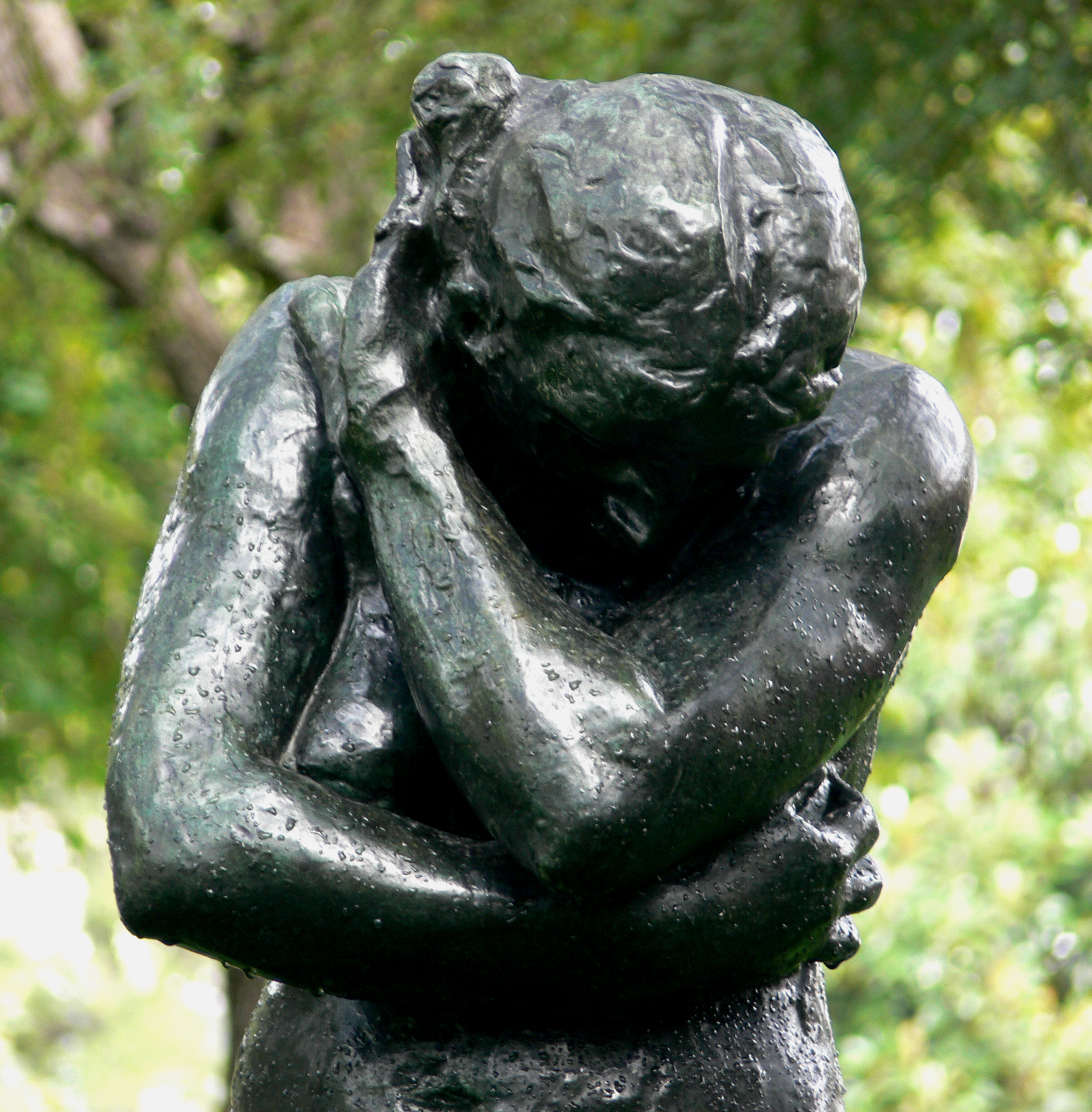
Though we spent less than an hour at the Joslyn Art Museum, it was meditative time well invested. Upon exiting the European art section, there was a small room containing a Monet painting and a small bronze statue of Auguste Rodin's Eve. Unlike many portrayals I have seen of Lady Eve, this one was not sensual nor was it sanitised. There she was, naked, with no hand covering her sexuality, no long hair hanging down to hide her womanhood; she hid only her face. Though she was bronze she was not brazen—contorted in remorse and agony for the curse she had unleashed upon mankind. When I gazed upon this mortified Eve, I saw fear and sorrow. I saw vulnerability. I saw humanity in the wake of the Fall. I saw the hope of repentance. I saw myself.


How can human hands take cold metal, making it live in ripples, effulgence, and emotion? How could the artist cast one woman who would resonate with so many of the women who gazed upon her abject form? Yet somehow, in broad strokes, Rodin made just such a woman. Eve in all her remorse and repentance was a woman—she was human. From this bitter moment of knowing sin, a veil was placed between God and man. 


From this time forth, humans began to hide—and we choose to hide behind much more than fig leaves and excuses. We hide behind our accomplishments or our identity, behind our careers, cars, or kids. We hide behind walls that we have built, brick by brick, barb by barb. We hide behind our intellect and our to-do lists, behind styles and having it all together, behind addictions and amusements—we hide because we are afraid. We are afraid that we aren't smart enough, handsome enough, or successful enough. We are afraid to let anyone see our mess, our turmoil, our uncertainties, our weaknesses and inabilities. And when our first emotion isn't fear, it is fear hidden under the guise of pride. We pride ourselves on our achievements or our brutal honesty or some other thing, in order to prove that we are enough, we are strong, we are worthy of love and acceptance, or at least of respect and awe.

What if we were like Eve, not hiding our humanity—for it is our glory, our being what we were made to be. What if we did not try even to turn our eyes away from our Maker in agony and ignominy? What if we recalled Isaiah's words, that our Maker is our Husband and that the Holy One is also our Redeemer (Isaiah 54:3)? What if He turned our faces toward Himself, sought our eyes with His, and called us His belovéd? There is no "what if?" about that—He does exactly that. From the very first He has pursued us. 


Beginning with Adam and Eve, in the cool of the evening the Lord sought them, He called out to them "where are you?" (Genesis 3:9). Adam answers the way I so often do, "...I was afraid, because I was naked, and I hid myself." (Genesis 3:10) "...I was afraid, because I was naked..." I was afraid to come to You, Lord, because You would see through my accolades, accomplishments, and intellect. I felt vulnerable and raw, so I didn't want to come before You. I have sinned and I couldn't wash it off. I want to fix myself before I come to You. Slowly, slowly I am learning that this is when He cups His hand under my chin and searches out my eyes. The searing Love in His own eyes burns away my impurities, illumines my darkness, heals my brokenness, makes me worthy. It isn't that there is no consequence for sin, there is. Yet it remains that the payment was made by the injured party. The One who covenanted with us is the One who paid the redemption price when we broke the covenant. The Holy One is our Redeemer.


Like Eve, I forget the kindness of God that leads to repentance and I can think only of His Holiness. I forget that His wrath is directed toward my sin, not my self, so I hide. I try to be fit enough, smart enough, encouraging enough, anything-else-enough-to-atone-for-myself—except being vulnerable enough, honest enough, and humble enough to come before Him. 


The irony in all my fears, in all my brokenness, is that I deeply want to be known—to have someone know me as I am and not walk away. Those great theologians, 
the Goo Goo Dolls, put it this way: And I don't want the world to see me/'Cause I don't think that they'd understand/When everything's made to be broken/I just want you to know who I am1. They understand the ache of every human being, the desire to be known—but also the fear of being known. We don't want the whole world to see us as we are, just the one person who will know us for ourselves and not run away. It is a scary thing to be vulnerable with another person. What if they betray you? What if they reject you? What if they take what they know about you and use it against you? That is the risk of love. A risk we fear and long to take, all rolled together.


Love is the risk God chose to take on mankind. He chose to create Adam and Eve, though He knew the Fall would happen. He chose to love them, even though He knew they would choose not to trust Him and would break the world He entrusted to them. He chooses to love us, even though we put up walls or try to win approval rather than receiving His gifts of love, reconciliation, and redemption. He chooses to love us, even though we often snatch gifts from His hand, yet run away from Him when we don't get our way. And even when we nail Him to a cross with our manifold sins, piercing Him to His very heart, He still loves us.


Perhaps I see less of myself in Eve after all—at least she stood before her maker in all her nakedness and sorrow. I run from my Maker in those moments, or try to cover myself with the flimsy fig leaves of my accomplishments and intellect. I ache to be known, yet I fear it. I want to be naked and unashamed before my Maker rather than clothing myself in my own attempts at being "enough".


“You come of the Lord Adam and the Lady Eve," said Aslan. "And that is both honour enough to erect the head of the poorest beggar, and shame enough to bow the shoulders of the greatest emperor on earth. Be content.2

O my Maker-Husband, let me be content in Your Love. Let me be vulnerable enough to come before You. Make me able to know that You are enough and that You make me worthy.


_______________


1. The Goo Goo Dolls, Iris (Written by John Rzeznik, Warner Bros. 1998)

2. Lewis, C. S., Prince Caspian (Scholastic Inc., New York, 1987) 211-212

All Scripture is taken from The Holy Bible, English Standard Version Copyright © 2001 by Crossway Bibles, a publishing ministry of Good News Publishers.

Tuesday, November 3, 2015

Refusing to be 'Singled' Out


How Should the Church Treat Singles?

“Another one bites the dust” is the relationship theme song I resonate with lately. I can barely go a month without one of my friends telling me they are dating or engaged. I have been in—or behind the scenes of—quite a few weddings in the last year or two. This is not the first round of this life-season for me. It happened a couple of years after high school, again after my higher education terms, and now that many friends are approaching their late twenties and thirties. There have been quite a few seasons of babies among my friends, too. It is a constant ebb and flow.

None of this is surprising—it is the rhythm of life. It feels new and exciting and surreal when it happens to you or your closest friends, but it sounds pretty normal to everyone else. What might sound abnormal to some is that I am pleased for my friends, but I don’t want to be in their shoes. Oh, I have twinges of unfulfilled hopes when I watch the father-daughter dance at weddings. I am human, I want someone to go through life with—to care about and to be vulnerable with. Sappy songs make me sad every now and then. Sometimes I feel at loose ends, like I should have someone to share something with, but they aren’t there. The longing to be loved is natural, put in our hearts by Divine Love himself.

More often than not, however, I am thankful to be single. Singleness is not synonymous with loneliness. This truth often seems to evade people—especially church people. They ask some strange questions at times, and snarky me replies in my head (well-taught-me answers with much more tact). The one I hear most often rings hollow to me, “About the time I became content with my singleness, I met my spouse.” Strange, I think to myself, I’ve been contentedly, cheerfully, single for many years and ‘Poof!’ I have no husband. Thanks for sharing without caring to enquire whether or not I enjoy being single. Every now and then someone will tell me (none-too-subtly) they would like me to meet their son, though no one has ever followed through on helping such a meeting to take place. Now, I’m not opposed to getting married, it simply isn’t my calling at this point—I am quite satisfied with all that I have and am called to right now.

Words upon words have been written about relationships—both the dating kind and all others (as if those are the only two categories there are). I have heard plenty of married people tell me they wished they had enjoyed their single years while they had them. Many a single friend has told me of their ache to be married. That pain is real, I understand. Usually, I choose not to add my voice to those conversations, as they have been had many times already by people who are wiser than I am.

Rather, I choose to opine about feeling like someone who grew a third head on the spot, or like the Invisible Man at various church gatherings. How should the church treat singles? For starters, it would help not to be pitied or unseen. Singleness isn’t a disease. It would also be great if people wouldn’t ask all those frustrating questions—”Have you tried online dating?”—as if I were dying to get married, or am unaware of how to meet people of the opposite sex. If you are so concerned, invite a few unmarried men and women over for dinner so they can spend time together comfortably. It would be a relief not to be “singled” out—either made an outcast or lumped into groups of other single people. What I am trying to say is that it would be helpful if singles were treated simply as human beings, not as ‘singles’. We are persons, not slices of Kraft cheese.

Churches that don’t have a singles’ group receive my mental applause. The ones that have small groups of mixed ages are hailed with gratitude. How will I ever learn what marriage is if I don’t see it lived out in front of me (in others besides my parents)? Peer groups often feel like the blind leading the blind. I need folks who are older and wiser than I am speaking into my life, telling me their stories, sharing their wisdom and what God is teaching them through Scripture. I have friends in their forties, fifties, and sixties with whom I love spending a long evening—to hear and to share about life and Godliness. I probably need more of these friends. These are the friends who share their homes, their meals, their thoughts on literature and society—the friends who open the Word of God to me.

We are all human beings first. Yes, we are male or female. Married or unmarried. Old or young. Gifted in this or gifted in that. Dichotomies aside, however, we are all in need of Love, of Beauty, of being made Holy as God is Holy. We all need Truth to anchor our lives. We need our family and friends. We need to give and to receive—graciously, humbly. We need stillness and the sounds of life. We need time alone and time in fellowship. We all need Jesus.

Why focus on the things that divide us? Perhaps that is the reason I don’t like being labelled “single”—or “female” or “white” or whatever other label people try to stick on each other. It is not an us-against-them sort of life. Life that truly is life is lived together—and that is much harder than separating off into our little factions or comfortable autonomy, isn’t it?