Showing posts with label Imago Dei. Show all posts

Thursday, April 28, 2016

Have You Noticed Beauty?


A man should hear a little music, read a little poetry, and see a fine picture every day of his life, in order that worldly cares may not obliterate the sense of the beautiful which God has implanted in the human soul. 
—Johann Wolfgang von Goethe


I have notice that many folks claim that humans are animals. After all, we are mammals and are classified as Homo sapiens in the scientific realm. But that is a mere classification. God tells is from the very beginning that humans are different than animals. We are made in the image and likeness of God. While the animals may also have been formed from the dust of the earth, it was only into man that God Himself breathed the breath of life. 

I have noticed something else: all animals eat food, but only human beings arrange food on their plates and take photos of it. Only humans stop to watch the sunrise or the moonrise for the sheer beauty of it. Only human beings write poetry or draw and paint—even from the dawn of time. When Adam first speaks of Eve, it is recorded in a couplet. When Eve is tempted by the serpent, she sees that the tree is pleasant to the eye. Perhaps it is a few readings too many of Lewis and Tolkien for me to hope that God formed and filled the world by singing the words of creation. Even if He did not, two books of His word brim with poetry and songs. 

I have noticed that on my most exhausting days of travel or work what I long for is Beauty. To watch the sun set and the stars creep into the sky, one by one and then in clusters. To read a story or a poem. To listen to an album straight through while I eat my dinner. To dance in my kitchen. To make food, yes, but also to group it by colour on my plate. To sit down—feet free of shoes—listening to the evensong of birds give way to cricket choruses. To listen to an audio book because I'm too tired to read anything beyond five lines. 

I have noticed that when I'm not reading much or stopping to enter into the Beauty I see in creation, it is then that I have no words. I cannot write. I make a poor conversant. I feel too tired for friends. I run and run, but it is more like a crawling car on petrol fumes. In short, I get crabby and withdrawn when I am not able to be immersed in Beauty in some form. Goethe explains why: there is a sense of the Beautiful which God has twined into the human soul. We are different from the animals...and the angels, and from God Himself. Yet neither animals nor angels are made in God's image, only man is. We are distinct—imaging God in our very being, in our capacity to know and appreciate Beauty, in our cultivating and stewarding whatever things God gives to us, from children and gardens, to art and music. 

I have noticed that Beauty is a gift that we get to enjoy. That we are allowed to savour the words of a poem on our tongues. That our eyes burn with the glory of a sunset or a sky on fire with meteors. That our hearts nearly burst in the highest swell of a song, either poignant or joy-filled. It is a gift to know that Beauty itself is a gift. It is a gift to know God and to be known by Him. It is Beauty that leads us to praise. Beauty is our companion to draw us into worship. It is Beauty that beckons us to enter into itself and find that we are in the courts of God. Beauty it is that leads us further up and further in.

Have you noticed?


Saturday, February 27, 2016

Edges


Five years ago, I walked the grey streets of Oxford, my mind gnawing on something that one of my tutors had said to me over coffee. Being away from home and all you know will make you feel the edges of yourself. He meant that I need not cling to my conservative moral beliefs while I was out from under the eyes of people who knew me. I think he was worried that I was naive and easily led, rather than a tenacious soul who poked at ideas to make sure I knew what they really were before—or even after—believing them. Thankfully, I had spent many months and years thinking over the things I believed and why. I may have appeared fresh-faced and over-trusting, but underneath, I had at least a bit of perspicacity.

My tutor was right about something, however—Oxford did make me feel the edges of myself. I knew where I stopped and the ancient stones began. I knew—perhaps more intimately than ever before—how small I was. I knew I was nothing special, yet simultaneously unique and necessary, because God had chosen to form me and bring me to life at a given point in His story. 

Since my term in the City of Dreaming Spires, various events and seasons in life have made me feel the edges of myself. In Oxford, it was both the unfamiliarity of the city and the suddenness of the adventure given to me. The city was established and bold, ever busy and meandering like the Thames. It made me feel young and small, but adventurous and curious—much like a child who is afraid of the dark, but unafraid to ask 'embarrassing' questions or play make-believe as if it were real. I felt solid, at home, present in Oxford.

Other experiences have made my edges known in precisely the opposite way. I have felt like the proverbial fish out of water, disoriented and unable to think clearly, let alone ponder slowly and deeply. Sensory overload and all-things-new have made me cling to God, knowing my best defence was to take a deep breath. Inhale. Lord have mercy. Exhale. Christ have mercy. 

In the midst of feeling uprooted I pray frantically, I don't know anything, I have nothing solid under me... Jesus, anchor my soul, keep me from drifting. I don't know, but I trust You. His steadying hand isn't always tangible. Sometimes I flail while He holds me, until I tire out enough to hear His whispered, Peace. Be still. It's His call to stop thrashing and know that I am held. I am loved more than I can understand with my questioning mind. When I don't know, I feel that my edges are dull—yet discernible. The Father's lithe hands grasp my slippery self and He holds me secure, bringing me to a place of quiet rest in the middle of uncertainty. 

When I feel most like myself, when I feel at home, my edges are distinct and crisp. When I feel least like myself, adrift in the scary ocean, my edges are still known, but blunted or warped. In both cases I am being shaped by the Maker. He helps me to grow deeper, healthier, and more like Himself. He shaves off my warty tendencies and calloused feelings to reveal that He is pruning me—from the edges inward—into His image. Christ have mercy.

Monday, February 8, 2016

Planned Obsolescence and a Culture of Death


"Oh, I know how to use that mixer, my grandma's is just like it!" I said to my hostess as she pulled out her mother's mixer. She looked pleased and then sighed, "Yes, this one is still plugging away, unlike the things they make now. Planned obsolescence they call it. So your products have a life-span of only a few years." The term was not new to me, nor the concept—but that didn't stop the conversation from bothering me. Manufacturers don't want to make a sturdy product, they want to make a cheap product that has you coming back to them every few years. They mismanage our resources—plastic, metal, glass, labour—in order to make a profit.

Far from being a mere economic tactic, planned obsolescence makes its way into other areas as well. The trend of building ugly-but-functional buildings has been the rage for quite a while, with the added 'luxury' of being able to demolish the building at will if it gets outmoded, overcrowded, underused, or any number of other reasons. When I lived in Oxford for a term, I felt at peace even on the fast-paced sidewalks, because I could always duck into an ancient alleyway, or take the next block up. Even if I stayed on George Street, the buildings were far older than anything Colorado can boast, the churches beautiful and unambiguously churches, and one could hear bells chime the quarter hours from anywhere in the city.

Oxford was not built to be replaced one building at a time—as evidenced by a building from the 1500s on a main thoroughfare. Granted, that house was being used as a mobile phone store, but they hadn't torn it down to build a disposable storefront. The English built things to last far into time. Architects like Christopher Wren built beautiful libraries, chapels, cathedrals, and colleges to last—sometimes dying before the work was finished because of the precision and enormity of the building process. It was no light matter to build a cathedral or a school. They would be a place of teaching and refuge for generations to come, they must be built well, they must be beautiful and inspiring in their construction.

This same mindset of building things to last was brought by the English who settled the American Colonies. The earliest cities in America have some lovely architecture, buildings that have withstood the elements and fads. However, in the early 1900s came this ploy of obsolescence. From buildings and cars to mixers and light bulbs, manufacturers began the process of making things disposable. Now we are deluged with plastic containers, glass bottles, and ubiquitous grocery bags made merely to be thrown away. I am two generations down from the 'Greatest Generation' who lived through the Great Depression and the recycling drives of World War II. In two short generations, we have gone from conserving to consuming-with-abandon. The shift began with things like planned obsolescence and it has grown into a killing field.

The industrial revolution turned the whole of humanity into two groups: consumers and producers. Distinctions made by man to obfuscate our calling as human beings, imaging God. Human beings began to be redefined under man's terms, a slippery position for anyone. When persons are defined as either consumers or producers, immediately they are given different values. Rather than the intrinsic worth of being human—made in God's image—humans are given arbitrary values based on their production or use in society. People become what they do, rather than who they are.

When a person too weak and small to fight for themselves is considered a hindrance, it's okay, they are disposable. A quick 'procedure' and presto! the unwanted 'problem' is gone. Snuffed out by 'progress' and a woman's 'right' to kill another person. But if you call a person a 'problem' and say 'remove tissue' rather than 'kill' it sounds less like murder—it's much more sanitary that way. What happens when a person is old and unable to contribute to society? They are shuffled off into homes; separated from families who need to be reminded that everyone deserves compassion, that they themselves are not immortal, that death comes for us all. But we shove aside death and thoughts of our mortality, rushing on in the consumer-producer wheel. Worse still, many elderly are shuffled off this mortal coil by doctors, nursing home workers, or other 'aides' when there isn't enough money or room to pour into a 'useless' person. But human beings are not machines, they are not their ability to produce. They are not animals. They are image bearers, beings—full of worth because they are made in the likeness of God, unlike any other creature.

Manufacturers are not really to blame for abortion and euthanasia—their planned obsolescence is only a symptom of a shift in thinking and beliefs. The philosophies of eighteenth, nineteenth, and following centuries have come to fruition in this culture of disposable stuff and disposable humans. If it breaks, buy a new one. If it's old, throw it away. The jump from stuff to humans isn't far when you base human value on what one does, rather than upon who one is. No wonder God calls us to be stewards, caretakers of resources (oil, plastic, glass, plants, time, money), as well as one another. We are to steward—guard and care for—human beings even more than we are to till the ground or cultivate our imaginations or repair our cars and mixers. We are to cultivate our hearts and minds and culture into thriving grounds for life.

Sunday, May 11, 2014

The Art of Grieving

Drip-drop. Drop-drip. Plink! Glorious Spring rain drips off the gutter-less eaves of my cottage this forenoon; every now and then one drop making a sharp ping off something metal below. Steady, strong notes to set the rhythm for the day, those water-drops. I draw icy water for the kettle, waiting for its warm whistle as a Southwest wind kicks up its heels. The song of the rain slows, softens, becomes silent. Whirling this way and that come the downy flakes of snow. 

Pungent Earl Grey tickles my senses as I gaze long at the steady, slanting white. I am very much alone, but not in the least lonely. Solitude need not make one solitary. Fog, snow, roiling grey skies – they are all friends. The damp, chill, and quiet give one time to pause, to recalibrate the soul toward stillness and Beauty. When we make the time to hush, not writing, nor reading, nor listening to the ever-present music that pervades our senses, we are able to be. We are able to grieve or mourn, to ponder and reflect, to pray and listen, to know and be known.

Stillness and reflection often seem colossal threats to our current 'culture of noise'. Particularly in the process of grieving, perhaps the greatest conundrum in this age. In times-not-long-past, there was a set period for mourning in which the mourner at the least wore a black band on their arm, if not complete outfits of black. Now we hardly even say someone has died, but that they have 'passed away'. We have funerals and weddings in 'Life Centres' at cemeteries. Our culture seeks to sanitise death from all its ugly brokenness. I am very, very pro-life, but even I cannot ignore the effects of the Fall. We cannot pretend that death is routine, neat, and 'part of life'. It is not. It is a violent affront to God the Creator. It is madness and fragmentation at their extreme end.

Grieving is a slow process; whether it is the death of a loved one, the loss of a friendship, or the crumbling of a cherished dream. It takes silence and prayer to walk the road of sorrow. Yet, not even the evangelical church seems to accept this. Half-truths are still lies, yet they ring forth from our Postmodern Evangelical churches and the reams of pages in 'Christian' bookstores: God must always make bad things good. We must always smile and say we are well, that it is good to be alive. Christians are always to be happy, happy, happy - which translates to fake, fake, fake. God will make all things well, but probably not the way we think He should, and often not on this earth. It is good to be alive, because we were made for life - but 'good' does not mean 'easy'. 

The Anglican response to death in the prayer book does not ignore the creeping shadow of death, nor does it wallow in the Fall. It brings one's focus back to God, the Author of life, the Redeemer of death:
Thou only art Immortal, Creator and Maker of mankind;
and we are mortal, formed of the earth, and unto earth shall
we return. 
For so Thou did ordain when Thou created me,
saying, “Dust thou art, and unto dust shalt thou return.”
All of us go down to the dust... 
Yet even at the grave we make
our song: 
Alleluia, alleluia, alleluia.
Even at the grave we sing of the Hope to come. We weep and mourn in Hope. This is not easy. We may sing our alleluias through teeth clenched, through stinging tears. But we have Hope: Jesus Himself, the Resurrection from the dead for all who are 'in Christ'. And when death takes from us one who does not know God, we lament even more. Again, we cannot pretend that death is normal. It is grotesquely abnormal. We still mourn loss. 

Learning to lament takes times of silence, of being. It can take the form of long walks, writing poetry, playing or writing music, cleaning vigorously, cooking and baking (for oneself or others), painting or drawing, gardening, crying, and many other things. Strikingly, lamentation is often pro-creative. By that I mean that we find an outlet for grief, anger, and sorrow in making, in serving. 

Look at the first line of the Memorial Prayer - it calls God three things: Immortal, Creator, and Maker. We tend to think of the last two words as being synonyms, but they are Names and have nuances. A 'creator' begets - the thing begotten is from himself, is part of himself, like a child shares the 'humanness'  and DNA of its parents. A 'maker' is a companion or a spouse, as well as one who designs or constructs. So, the act of creation is intensely personal and part of the creator-begetter. The act of making is taking something already in existence and fitting it together; as one takes flour, water, and yeast to make bread; or wood, nails, and varnish to fit into a wardrobe; or chisels and marble to form a sculpture; or a man and a woman together fashion a marriage. 

In grieving we image God by making. We turn to pro-creation to pro-cess (move forward, continue). We seek solitude and silence in order to better serve, because the act of serving (helping one's neighbour with various tasks, inviting others over for dinner, etc.) brings us outside of ourself so that we do not dead-end in grief.

This brings up the other aspect of lamenting. To lament, I said, one needs times of solitude. But one also needs time with others. God says in the beginning that, "It is not good for the Man to be alone". God was right there with the Man, but still says he is 'alone' or without a match (or mate) of his own. We need other persons. We need friends and family who will be still with us, who will listen to us. We need others to serve with our creative acts. We need those close to us to cry with us, and also to make us laugh. 

The hush of snow is heralding a chance to ponder, time to be. This late Spring snow is a gift before I step into the bustle of Summer. The silence of a full day to process and grieve is worth the thanks-giving. Right here and now I learn to be still and know... and to be known.

Alleluia, alleluia, alleluia!

~ Johanna


Friday, December 20, 2013

Reflection or Merely Recounting?

[Advent Week 1 - Posted a bit late]

The season of "Here is what I did this year" letters is upon us. Yes, most people call them 'Christmas letters' but they are more truly year-in-review letters. I am not guiltless of this practise when replying to long-overdue e-mails or letters, but I try to have the decency of not calling those communications 'Christmas letters' either. A Christmas letter ought to be about Christ, whom we remember became man at one specific point in history. Whether it was in December or April or some other month I really do not care. We pick the busiest time of year for reflection on this point of truth, so I plan to reflect on it. 

Perhaps this time of year is the busiest because the enemy of our souls despises stillness and reflection upon Jesus. If there are more and more Christmas parties and stresses and less and less meditating on Christ, that enemy is accomplishing his underhanded goal: distracting us from setting our eyes where they ought to be. We need to see Christ, not ourselves, our busy lives, or our accomplishments. Paradoxically, the more we set our eyes on Jesus, the Author and Finisher of our faith, the more clear and correct is our view of ourselves. 

Those year-in-review letters that so many of us write focus on our highlights, sometimes our low points, and rather useless information about our corporal man which is passing away. That is all merely recounting. Real reflection is not that at all. Reflection is 'looking back' on the blessing God has given, on the lessons He is teaching, and seeing His strength and hope bringing you through your darkest moments. In short, reflection is seeing the Glory of God shining back to Him through yourself in circumstances and quiet moments. How do we know that reflection if we are not focussed firstly on the real, the true image of God, Jesus Christ?

So, in the busiest season of the year let us strive to make time for stillness and solitude daily. Let us fix our eyes on Jesus, who is before (both 'prior to' in history, and 'ahead of' as an example) us. Let us know Him as He IS, so that we might reflect His glory and His image.

~ johanna

Monday, January 21, 2013

Music: Heart and Soul

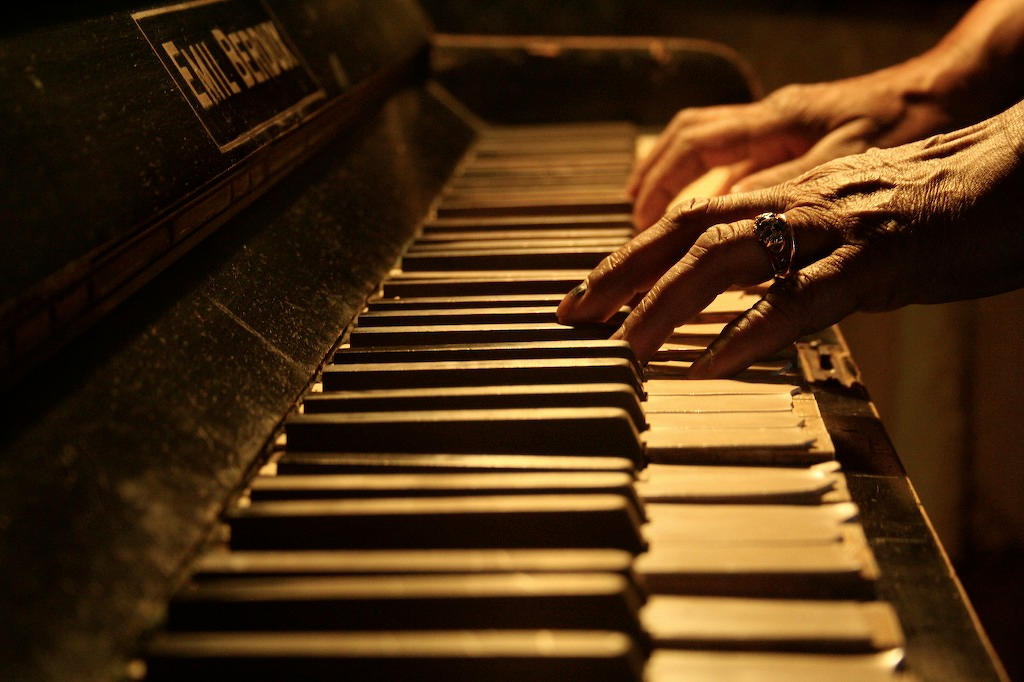
Do you ever wish you could sit down at a piano and have your ideas flow out of your fingers? Perhaps you can do that. I cannot. I have a hard enough time letting my thoughts flow through my fingers to the pen or keyboard. But music... Music has a way of reaching to our souls more deeply than so many words on a page.


A lively tune can set our feet and hearts to dancing. Some songs pierce our hearts with their Beauty, their depth. Other pieces rend our hearts with their pain and loss. Music can make us feel courageous, patriotic, melancholy, vulnerable,  pensive, inspired, or cheerful. Music can both break our hearts and mend them.

Music is something to which we respond. It moves us, makes us, breaks us. Yet we make music, we break music (rap?), we try to make it fit to ourselves. One of my former tutors wrote a short bit about this here: Symphony As Landscape. The comments he made intrigued me: 
"For me, the music is not a soundtrack to something else; it is its own reality and it makes a first claim on me. Put very roughly, as I listen, I surrender my attention to it; I am less important than the music and my attention is on it and not on anything else. I am aware of its contours and features; my feelings about them are secondary, not primary."
(Rikky Rooksby)

There is something remarkable about music... It is both a thing to tame and create, as well as a thing that creates various feelings, moods, or resolutions within us. It is obviously a gift from God -- only God's gifts are set in tension like that.

Music is not simply 'background noise' - it is its own 'self' as it were. It has a personality imbued from its creator, yet it has themes and lines of its own, apart from how the composer may have planned things. Visual arts, writing, crafting things, music -- they all have a way of taking on a direction and 'self' of their own. If the creator is willing to let his work live, that is. I think it is these moments in our work, our play, our sub-creating where we most 'image' God. When our work takes on its own 'personality', it is often then that God speaks to us (and others) through us. We just have to step aside and let Him breathe the life into the work.


~ Johanna

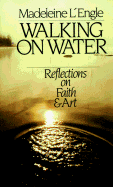
For more thoughts on this, please do yourself a favour, read The Mind of the Maker by Dorothy L. Sayers, or Walking on Water by Madeleine L'Engle.

Post Script:  I write this from an writer's perspective, not a musician's. A musician would more deeply understand the soul and the way of music. I can only try to grasp a little of how music influences me, and how (like other mediums), music is its own being with its own 'personality'.

Thursday, January 3, 2013

To Love is to Name

To love anyone is to hope in him always. From the moment at which we begin to judge anyone, to limit our confidence in him, from the moment we identify [pigeon-hole] him, and so reduce him to that, we cease to love him, and he ceases to be able to become better. We must dare to love in a world that does not know how to love.

~ Madeleine L’Engle quoting a French priest in Walking on Water (pg 112)


This quotation is staggering. It has gnawed at my heart since I first read it several weeks ago. When we reduce someone to a label, we effectively terminate their ability to change or become better; both in our own minds, and often in actuality.  We assume someone cannot grow, cannot improve, cannot be anything other than that little title with which we have branded them. In this suspicion we begin to treat that person as if they really are that one thing, as if they can never aspire to be a multifaceted human being.

Goth. Punk. Prude. Gossip. Ringleader. Hyperactive. Emotional. Holier-than-thou. Type-A. Shy. Geek. Blue collar. Hoity toity. Snob. Redneck. Intellectual. You have a mental image for each one of these words, I daresay. Once you classify someone (as if they are a science experiment!), you reduce their humanity to one facet, rather than seeing them holistically.

“It seems that more than ever the compulsion today is to identify, to reduce someone to what is on the label. To identify is to control, to limit. To love is to call by name and so open the wide gates of creativity. But we forget names and turn to labels... If we are pigeon-holed and labelled we are un-named.”
 ~ Madeleine L’Engle, Walking on Water (pg 113)


I say 'you' above, but I am  not exempt from the classification game. There is a particular person whom I have, by my actions toward her, never allowed to be fully human (in my mind). I put her into a box with a label or two scrawled on it, and filed that box on the shelf. The problem is, by my actions, that person has been stunted. She behaves as if she believes she is what I (and others) have labelled her. In so doing, she imprisons herself to be only so many little labels. This is her choice,  of course, but she may chose better things if more persons believe her capable of them. She might be named if she were loved well and lived in light of that love.

Yet another difficulty arises when we attempt to (or succeed at) pigeon-holing someone: persons do not fit neatly into a box, even if pigeons do. Persons are messy, unpredictable at various junctures,  and unique from every other human being in certain points (from DNA to fingerprints and beyond).

What kind of Love names someone? What Love is this, that allows persons to become fully alive?

But now, thus says the Lord, who created you, O Jacob, And He who formed you, O Israel: “Fear not, for I have redeemed you; I have called you by your name; you are Mine. 

When you pass through the waters, I will be with you; And through the rivers, they shall not overflow you. When you walk through the fire, you shall not be burned, Nor shall the flame scorch you. 

For I am the Lord your God, The Holy One of Israel, your Saviour; I gave Egypt for your ransom, Ethiopia and Seba in your place."
 (Isaiah 41:1-3)

God speaks thus to Israel in ancient times, yet He offers redemption to more than just this select group of persons. More than 600 years later He offers not nations for a ransom, but His only Son to be the Saviour of the world (I John 4.14). God Himself is Named --  not labelled, but Named. What is the difference? A label is something someone puts upon another, not allowing them to be more than that. To be Named is vastly different. Naming is an action, a calling one up and in to greater things. 

God is the only One with the authority to Name Himself, calling Himself "I AM that I AM" to Moses. Throughout Scripture He reveals His character through various names and actions: Wonderful Counsellor, Almighty God, Everlasting Father, Prince of Peace, God with us, Saviour, Holy One of Israel, Redeemer, Healer, Judge, Creator, Keeper, Warrior, Strong Tower, Refuge, and myriads of other names. God also Names us, He calls us to be who He made us. He calls us image bearers, children, friends, servants, belovéd, holy, priests, and many more names. 

Through God's love we are able to Name others, to call out in them those things that mirror God. Through indifference, rejection, and labelling we un-name persons. Will you join me in seeking to Name others this year? It will require a lot of humility in asking others to forgive you for un-naming them. It will require vulnerability to love others, even when they do not love you. It will take copious amounts of patience and perseverance to show God's kindness to some people. And none of those things come naturally to us in our fallen state. Loving others, Naming others, will require asking God for the above qualities, and seeking His strength to be made perfect in our weakness.

“Fear not, for I have redeemed you; I have called you by your name; you are Mine.
(Isaiah 41.1b)

~ Johanna

Monday, September 3, 2012

Imago Dei

Do you ever wonder what it means that we are created in the image of God (imago Dei)? Do we look like God somehow? Perhaps the things we do image Him. After all, He made us sub-creators in His creation, cultivators in His garden of earth.

Many Christian writers and thinkers of our present time point to being sub-creators as one of the chief ways we reflect God's image. However, there are some puzzling conclusions when drawn out to that end. What about persons who are sleeping, or in a coma, or whose brain function is very low, or the unborn? Does one's lack of 'sub-creating' make them sub-human, or un-human, or less able to 'image' God?

God did not make us human doings, He made us human beings. We are not part of the animal kingdom, we are not under the dominion of anyone but God Himself. He made us intentionally both to be and to do. The King of the universe made us in His image, possessing authority over all of this earth. Whether we are creating business, tools, art, homes, relationships, music, food, et cetera, or whether we are sleeping, in a coma, or are still in the womb, we are human beings, distinct from every other created thing.

Human beings appreciate Beauty, something no other creature has the capacity to grasp. Further, only we experience the pang inside at the Beauty of deep oranges, pinks, and orchids that infuse sunset-spangled clouds. Plants and animals eat to grow and live, but human beings eat a variety of foods for their diverse flavours, even artistically arranging the foodstuff on their plates.

Look at the blue sky, the tufted clouds filtered through shiny green oak leaves. Listen to the birds trill, the crickets chant their clarion call. Listen to the wind crashing through leaf-clad branches, smell the lashing rain on the soil, and see the fierce flashes of heaven-flung fire. Feel the fresh breath of the wind, taste the first flakes of snow, drive with the windows down (and the radio off) just because.

Have you yet learnt to be alone with your thoughts? Can you go a day without background music? Do you know how to sit still without even a book or a pen in hand? Chances are that you have not learnt these things either at all, or as well as you would like. 

Even on those rare occasions when a modern undergraduate is not attending some such society he is seldom engaged in those solitary walks, or walks with a single companion, which built the minds of the previous generations. He lives in a crowd; caucus has replaced friendship.

We live, in fact, in a world starved for solitude, silence, and privacy: and therefore starved for meditation and true friendship.
~ C. S. Lewis in his essay, Membership  

As a human being, I grow weary of the pull others place upon me. "What are you doing with your life?", "Are you planning to go to college?" (really, I am 27-years-old, can you please stop asking this one?), "What is next for you?", et cetera. Perhaps I ought to reply, "I am being where I am." Part of being involves work, friendships, reading, hiking, cooking, studying, and the like. But it is more, it is deeper, it is knowing that those things don't make me who or what I am. I am imago Dei, not of my own choice, power, or ability, but by His kindness, good will, and authority.

"I would rather be what God chose to make me than the most glorious creature that I could think of; for to have been thought about –born in God's thought– and then made by God, is the dearest, grandest and most precious thing in all thinking."
~ George MacDonald