Showing posts with label The Human Condition. Show all posts

Sunday, November 8, 2015

To Be Fully Known


And I don't want the world to see me...
...I just want you to know who I am1

Omaha, Nebraska. That paragon of culture is precisely where I spent a long weekend with friends. Now, I know that many of you will think of steak, cornfields, and farmers when you hear the word Nebraska, but there is quite a lot to that Plains State aside from plains. The highlights of my weekend were all cultural experiences: from the Joslyn Art Museum, a symphony, and a gourmet dinner, to a tea emporium, exploring the grounds of a mansion, and spending time in prayer at a beautiful Catholic edifice.


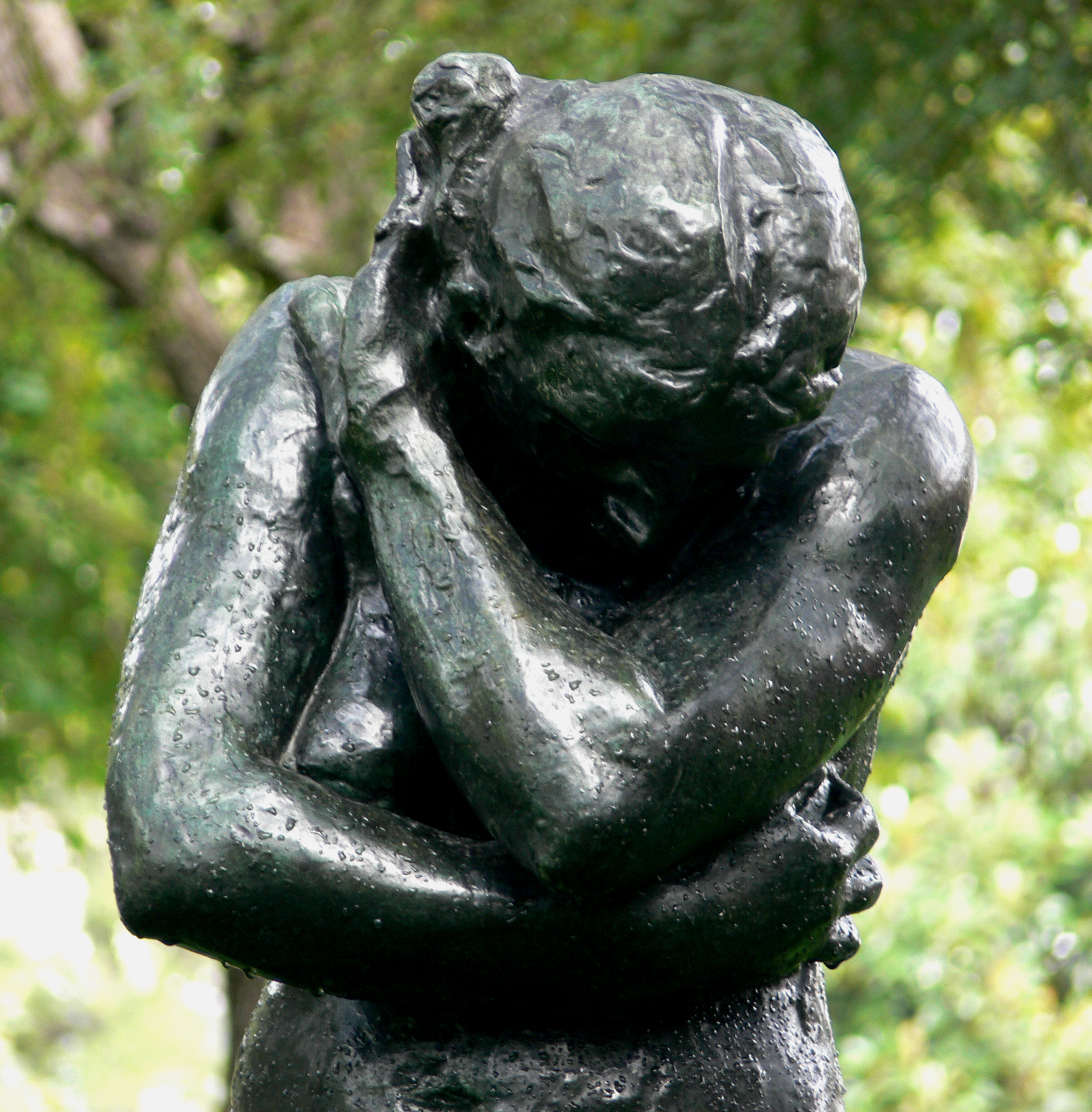
Though we spent less than an hour at the Joslyn Art Museum, it was meditative time well invested. Upon exiting the European art section, there was a small room containing a Monet painting and a small bronze statue of Auguste Rodin's Eve. Unlike many portrayals I have seen of Lady Eve, this one was not sensual nor was it sanitised. There she was, naked, with no hand covering her sexuality, no long hair hanging down to hide her womanhood; she hid only her face. Though she was bronze she was not brazen—contorted in remorse and agony for the curse she had unleashed upon mankind. When I gazed upon this mortified Eve, I saw fear and sorrow. I saw vulnerability. I saw humanity in the wake of the Fall. I saw the hope of repentance. I saw myself.


How can human hands take cold metal, making it live in ripples, effulgence, and emotion? How could the artist cast one woman who would resonate with so many of the women who gazed upon her abject form? Yet somehow, in broad strokes, Rodin made just such a woman. Eve in all her remorse and repentance was a woman—she was human. From this bitter moment of knowing sin, a veil was placed between God and man. 


From this time forth, humans began to hide—and we choose to hide behind much more than fig leaves and excuses. We hide behind our accomplishments or our identity, behind our careers, cars, or kids. We hide behind walls that we have built, brick by brick, barb by barb. We hide behind our intellect and our to-do lists, behind styles and having it all together, behind addictions and amusements—we hide because we are afraid. We are afraid that we aren't smart enough, handsome enough, or successful enough. We are afraid to let anyone see our mess, our turmoil, our uncertainties, our weaknesses and inabilities. And when our first emotion isn't fear, it is fear hidden under the guise of pride. We pride ourselves on our achievements or our brutal honesty or some other thing, in order to prove that we are enough, we are strong, we are worthy of love and acceptance, or at least of respect and awe.

What if we were like Eve, not hiding our humanity—for it is our glory, our being what we were made to be. What if we did not try even to turn our eyes away from our Maker in agony and ignominy? What if we recalled Isaiah's words, that our Maker is our Husband and that the Holy One is also our Redeemer (Isaiah 54:3)? What if He turned our faces toward Himself, sought our eyes with His, and called us His belovéd? There is no "what if?" about that—He does exactly that. From the very first He has pursued us. 


Beginning with Adam and Eve, in the cool of the evening the Lord sought them, He called out to them "where are you?" (Genesis 3:9). Adam answers the way I so often do, "...I was afraid, because I was naked, and I hid myself." (Genesis 3:10) "...I was afraid, because I was naked..." I was afraid to come to You, Lord, because You would see through my accolades, accomplishments, and intellect. I felt vulnerable and raw, so I didn't want to come before You. I have sinned and I couldn't wash it off. I want to fix myself before I come to You. Slowly, slowly I am learning that this is when He cups His hand under my chin and searches out my eyes. The searing Love in His own eyes burns away my impurities, illumines my darkness, heals my brokenness, makes me worthy. It isn't that there is no consequence for sin, there is. Yet it remains that the payment was made by the injured party. The One who covenanted with us is the One who paid the redemption price when we broke the covenant. The Holy One is our Redeemer.


Like Eve, I forget the kindness of God that leads to repentance and I can think only of His Holiness. I forget that His wrath is directed toward my sin, not my self, so I hide. I try to be fit enough, smart enough, encouraging enough, anything-else-enough-to-atone-for-myself—except being vulnerable enough, honest enough, and humble enough to come before Him. 


The irony in all my fears, in all my brokenness, is that I deeply want to be known—to have someone know me as I am and not walk away. Those great theologians, 
the Goo Goo Dolls, put it this way: And I don't want the world to see me/'Cause I don't think that they'd understand/When everything's made to be broken/I just want you to know who I am1. They understand the ache of every human being, the desire to be known—but also the fear of being known. We don't want the whole world to see us as we are, just the one person who will know us for ourselves and not run away. It is a scary thing to be vulnerable with another person. What if they betray you? What if they reject you? What if they take what they know about you and use it against you? That is the risk of love. A risk we fear and long to take, all rolled together.


Love is the risk God chose to take on mankind. He chose to create Adam and Eve, though He knew the Fall would happen. He chose to love them, even though He knew they would choose not to trust Him and would break the world He entrusted to them. He chooses to love us, even though we put up walls or try to win approval rather than receiving His gifts of love, reconciliation, and redemption. He chooses to love us, even though we often snatch gifts from His hand, yet run away from Him when we don't get our way. And even when we nail Him to a cross with our manifold sins, piercing Him to His very heart, He still loves us.


Perhaps I see less of myself in Eve after all—at least she stood before her maker in all her nakedness and sorrow. I run from my Maker in those moments, or try to cover myself with the flimsy fig leaves of my accomplishments and intellect. I ache to be known, yet I fear it. I want to be naked and unashamed before my Maker rather than clothing myself in my own attempts at being "enough".


“You come of the Lord Adam and the Lady Eve," said Aslan. "And that is both honour enough to erect the head of the poorest beggar, and shame enough to bow the shoulders of the greatest emperor on earth. Be content.2

O my Maker-Husband, let me be content in Your Love. Let me be vulnerable enough to come before You. Make me able to know that You are enough and that You make me worthy.


_______________


1. The Goo Goo Dolls, Iris (Written by John Rzeznik, Warner Bros. 1998)

2. Lewis, C. S., Prince Caspian (Scholastic Inc., New York, 1987) 211-212

All Scripture is taken from The Holy Bible, English Standard Version Copyright © 2001 by Crossway Bibles, a publishing ministry of Good News Publishers.

Sunday, August 10, 2014

Only Human?


Imagine you are conversing with someone—a barista, the mailman, your mom, a close friend—and the conversation turns to an error that person made and they say, "Oh that mistake was a doozy! But I'm only human." They might even grin and shrug it away, chattering on as before. In fact, you may have made this very remark yourself at some point. If so, stop it. 

You and I are human beings. Our humanity is not an excuse—it is who and what we are. Not only human or merely human, but human in an of itself. As Aslan once explained, “You come of the Lord Adam and the Lady Eve... And that is both honour enough to erect the head of the poorest beggar, and shame enough to bow the shoulders of the greatest emperor on earth. Be content.”1

Be content—we were made in the image and likeness of God.2 As such, we are distinct from every other creature in existence. We were made to be fully human—that is not a flaw, it is our rôle. We do not need to become less human, but more. All persons are shattered by the Fall, torn to bits and fragments of humanity. We are often more capable of being inhumane (sub-human, if you like) than we are of being human. Restoration of humanity means being completely human.

Someone might  inquire, doesn't the Bible say that we should decrease and God should increase in us?3 How does that point to us needing to be more human not less? Perhaps that is a misinterpretation of John the Baptist's statement, yet it raises a worthy point. If we are made in God's likeness, then we should be like God. Where do we take cues on how to be more like God? In the person of Jesus Christ. Jesus was the fullness of God in human flesh, but He was also the fullness of humanity in that sun-scorched skin.

Colossians two says it this way: "For in Him [Christ] dwells all the fullness of the Godhead bodily; and you are complete in Him..."4 I swim in waters far over my head when I begin thinking of "the fullness of the Godhead", but there that fullness is, in the person of Jesus. Further, we are completed in Him, made full in Him. We do not contain the fullness of the Godhead, we are too finite for that—but we can become completely human in Christ. I leave you to wrestle with the Scriptures in how to become more like Christ. I tremble before the Spirit of God as He sets my fractured soul in a myriad of places. Being made whole hurts, but it is good. Let us be content in nothing short of being human.


_____________________

1. Lewis, C. S., Prince Caspian

2. Genesis 1:26 (NKJV)
https://www.biblegateway.com/passage/?search=Gen+1%3A26&version=NKJV

3. John 3:30 (NKJV)
https://www.biblegateway.com/passage/?search=John+3%3A30&version=NKJV

4. Colossians 2:9-10a (NKJV)
https://www.biblegateway.com/passage/?search=col+2%3A9-10&version=NKJV

Monday, December 31, 2012

Solitude


“All of humanity's problems stem from man's inability to sit quietly in a room alone.” 
~ Blaise Pascal, Pensées

Evidenced by the fact that I began to listen to music  directly after typing that quotation. How quickly I forget that Beauty most often finds one in stillness. How readily I push aside God's messages delivered by silence and solitude. 

The whole world clamours and clangs with noise. Even our eyes are assaulted by 'visual noise' - billboards, skyscrapers and 1960s apartment buildings, badly hung Christmas lights, vulgar lawn ornaments, and the like. There is the disarray of 'stuff' all 'round us. Rather than making our lives better, 'stuff' can simply clutter our homes and gardens, as well as our thoughts. Many persons attest to being unable to think or study well in a messy area, myself included. 

Visual chaos and the din of television, films, iPods, et cetera almost constantly fill our minds or blunt our senses. "What of it?" one might ask. Think for a moment of what you do when you go for a walk or run. Do you put in earbuds? Talk on the phone? When you sit down at your desk or kitchen table, do you pull out your smart phone, computer, or a book? Can you fall asleep without music? Do you ever simply look out the window and think in silence?

Outside my window tiny white faeries flutter and float, flurry and fall. Trying to watch individual flakes makes me nearly dizzy, they are coming so quickly. There is something calming about snow, or a blanket of fog. Both give a covering of quiet to ponder, to let the thoughts we push away with noise come forth from their banishment: Do I have what it takes to be a man? Will anyone ever love me for who I am? What am I here for? Do I even make a difference? Is living any better than dying? What if so-and-so dies? How will I support myself when I am older? What will happen if other people find out how little I really know? Am I just faking it through life? Who is God? Is God really real, is He really there? Does God care about me? Why would He? Who am I, behind this skin and those eyes in the mirror - who is this I inside? 


In solitude and stillness I realise I have more questions than answers. Sure, I have a vague idea of how to answer some of the above questions. However, if I spent an hour thinking about Who God is, I might find how little I actually know Him. I know about Him, and in small degrees I know Him, as a person knows another person early on in a friendship. But do I truly know Him? 

When faced with thoughts about family or friends dying, I try to push them aside - usually successfully. It is too hard, too painful to think of them actually being gone from this life. Likewise, I am accomplished at ignoring thoughts about the future state of our government,  how long my bank account will be worth something, or where I will be in ten, twenty, or thirty years. I do not like depressing thoughts, yet sometimes I really do have to face them. Sometimes the pain from 'out there' comes 'in here'. The brokenness of the fall is not just for other people. I, too, experience the fall in my own circle of friends, in my own family, in my own life, in my own body.

Solitude brings these thoughts to the surface, rather rapidly, in fact. No wonder Pascal said that a man is unable to sit in a room quietly and alone. We want to be distracted from the questions  we cannot answer, the thoughts we do not like. We do not want to think about how far we fall short. We hide from rejection and loss. We block it all out with constant music (degrading the worth of music to mere background noise), non-stop communication, and busy-ness.

Have you been running away from your thoughts? Are you ignoring God's arms wide open to you by running the course of the noisy world? When was the last time you sat down to listen to God? Do you often (or ever) turn your phone, music, and computer off completely? Have you taken a walk in silence recently? When was the last time you faced your thoughts rather than fleeing them? How about practising solitude today... Right now.


~ Johanna


Sunday, June 17, 2012

Trajectory...

Happy those early days! when I
Shined in my angel infancy.
Before I understood this place
Appointed for my second race,
Or taught my soul to fancy aught
But a white, celestial thought;
When yet I had not walked above
A mile or two from my first love,
And looking back, at that short space,
Could see a glimpse of His bright face;
When on some gilded cloud or flower
My gazing soul would dwell an hour,
And in those weaker glories spy
Some shadows of eternity;
Before I taught my tongue to wound
My conscience with a sinful sound,
Or had the black art to dispense
A several sin to every sense,
But felt through all this fleshly dress
Bright shoots of everlastingness. 
       O, how I long to travel back,
And tread again that ancient track!
That I might once more reach that plain
Where first I left my glorious train,
From whence th’ enlightened spirit sees
That shady city of palm trees. 
But, ah! my soul with too much stay
Is drunk, and staggers in the way.
Some men a forward motion love;
But I by backward steps would move,
And when this dust falls to the urn,
In that state I came, return.
'The Retreat' ~ By Henry Vaughan 1621–1695


  Have you ever "felt through all this fleshly dress, bright shoots of everlastingness"? For a moment we see through a veil of rain into Heaven. We trace the golden light of a sunbeam back to its source: not the sun, but the One Who said that the greater Light should rule the day.

Moments flash upon us where we see through the curtain of temporal things into the world of the eternal. We see 'bright shoots of everlastingness' and have hope that this universe is not all there is. We have hope that our drunken souls will be sobered, and that we will make progress along the way.

Vaughan writes of travelling back to the time before his tongue could drip with sin, or before He walked far from his First Love. However, his last stanzas reveal that all he ever does is stagger backward like a drunkard. He hints that regression is not truly the right direction.

We cannot go back to some golden age, in our own life or in the world. We will not be 'returning to the garden of Eden' as I have heard even pastors declaim from the pulpit. No, we will be brought forward. God began man in a garden, but when we look at the trajectory of the Story, we see that he ends in a city. Not a city like we have ever known, however. This will be a city with a  River of Life, with trees whose leaves are for the healing of the nations (Rev. 22.1-2). We will be made better than we ever were. There is no retreat, only forward motion for us.


~ Johanna


Wednesday, May 30, 2012

Made for Some Reason


Surely a man of genius composing a poem or symphony must be less unlike God than  a ruler? But the man of genius has no mere by-products in his work. Every note or word will be more than a means, more than a consequence. Nothing will be present solely for the sake of other things. 
If each note or word were conscious it would say, "The Maker had me myself in view and chose for me, with the whole force of His genius, exactly the context I required." And it would be right – provided it remembered that every other note or word could say no less.

~ C. S. Lewis, Letters to Malcolm Chiefly on Prayer (pp. 54-55)

Words, words, words: God made the world and its contents with them. By the word of His mouth the heavens stand firm. The Son of God is called the Word (logos). Moreover, God reveals Himself most expressly in the words of a story contained in a book. That story is the great Story, complete with a plot, interwoven themes, protagonist, antagonist, and damsel in distress. The Story has a beginning, a plight, a climax, a liberator, an ultimate sacrifice, and is still in the throes of climax resolution. God tells His Story in a variety of lives and through numerous means: poetry, philosophy, narrative, historical accounts, and letters.

Did you know that you are a part of God's grand Story? Not only that, but in "the whole force of His genius" you are in the exact context that you require. You should not have been born two hundred years ago, nor two thousand years hence. You should not have been born into a different culture, on a different continent, or to a different family (even though your family life may have extreme brokenness, God can redeems and use even that). You should not try to be someone or something you are not. You do not have to fit into the box the world offers you. You were made to be the exact person you are to carry the Story further. Your line is not just your own, but it fits into the context of the Story right now.

This idea from Lewis surfaced in another book I read recently:  

"Did you ever notice that all machines are made for some reason?" [Hugo] asked Isabelle. "They are built to make you laugh, like the mouse here, or to tell the time, like clocks, or to fill you with wonder, like the automaton. Maybe that's why a broken machine always makes me a little sad, because it isn't able to do what it was meant to do... Maybe it's the same with people," Hugo continued. "If you lose your purpose... It's like you're broken."
 ~ Brian Selznick, The Invention of Hugo Cabret (pp 374-375)

 
If we lose our purpose, if we seek a different context than the one chosen for us, it is like we are broken. We are like a line read out of time, dropping the rhythm and rhyme. Have you ever felt out of time? As if your line had no context at all, let alone the 'exact right' sort? Perhaps you don't know what to do after school, or what job to look for, or whom you should marry, or whether you ought to remain single, or where you should live.  Maybe you feel trapped where you are. Are you really trapped, or do you no longer fit inside a constantly shrinking space?  Like a piece in a complicated machine, you will not simply 'do' in one of a number of places. You must fit exactly where the Maker has intended for you to go from the beginning.

That you are here—that life exists, and identity;
That the powerful play goes on, and you will contribute a verse.

 ~ Walt Whitman, O Me! O Life! (from Leaves of Grass)

And as Mr Keating (from my favourite film, Dead Poets' Society) asks his class, I ask you: what will your verse be?


~ Johanna

Sunday, August 7, 2011

Exposing the Lies of Lust

Hello new territory...

Normally my blog is a place where I discuss books (usually older books, at that) or things God has been teaching me through circumstances, etc. Today, however, I want to talk about an issue that churches are not dealing with: the struggle women have with lust.

Lust is not only a 'male problem' - it never has been. But we have been raised to think it is only guys who struggle with knowing where to set their eyes on a summer's day (one of my friends always said that summer was 'sidewalk season' because it was the only safe place to look). We are told that only men have a black thought-life, and only males are stimulated by scantily clad women on billboards or in the windows of Victoria's Secret.

But the secret is that women struggle, too. Probably not in the same way that men do - men and women think and process differently, of course. Yet lust is a human sin, not geared towards males alone. I have found this to be the case time and again with the girls I encounter... And I would be lying if I didn't say that those billboards, et cetera are distracting to me, too. Few churches (very few, in fact) address the issue, making young women feel like they are alone in their sin, having nowhere to turn in getting help.

Here I will turn things over to someone who has thought this through and polished her writing a bit more (okay, a LOT more) than I have. Please click the link below to read the full post. It isn't long and it is eye-opening.


We need to clearly teach that lust is a human condition, not just a masculine one. Knowing God's glory is at stake, we need to create humble church cultures where secret sin is not kept in the dark, but rather brought into the light...

...The roaring lion waits in the cover of darkness to attack what he finds there, but "whoever lives by the truth comes into the light, so that it may be seen plainly that what they have done has been done in the sight of God" (John 3:21).